

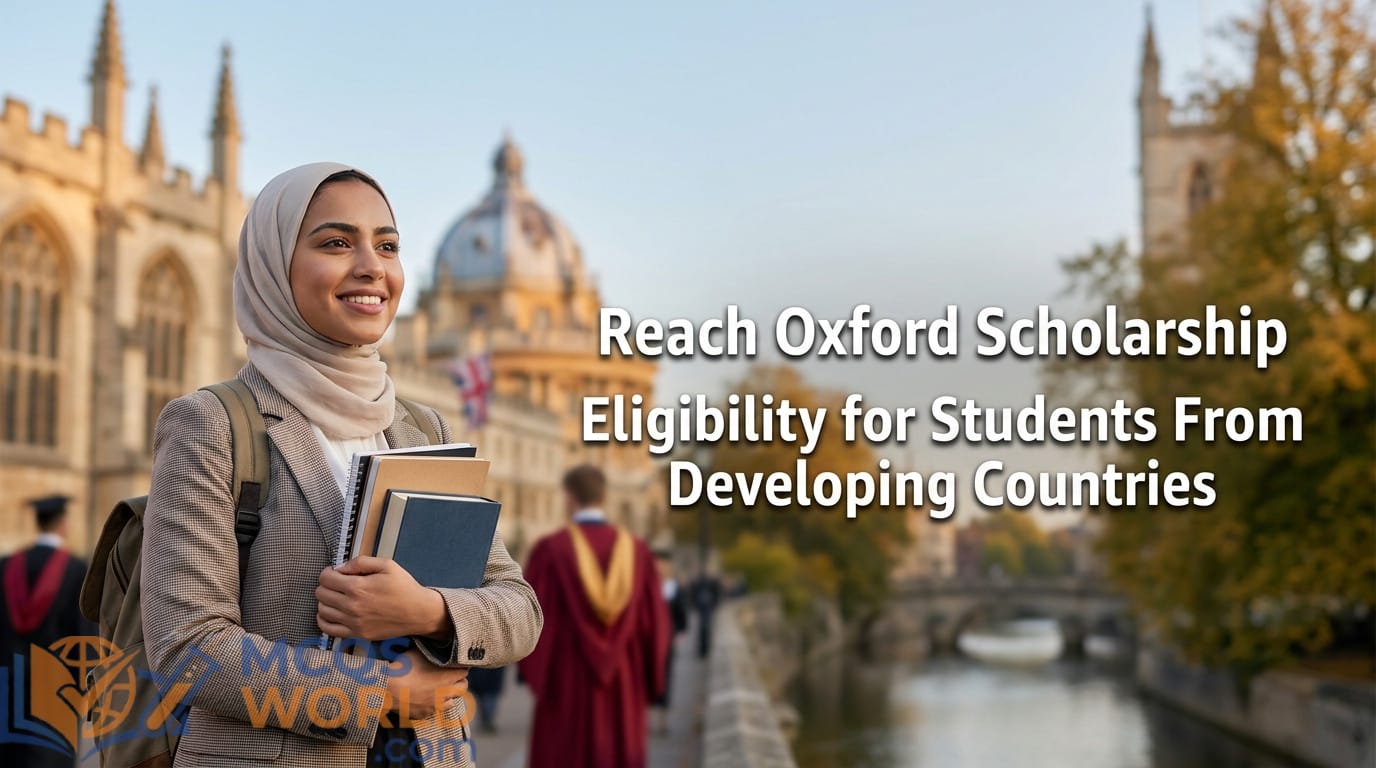
A student in Lagos or Phnom Penh with a strong secondary-school record and an Oxford offer letter in hand often hits the same wall next: there is no realistic way to pay for it, and no equivalent course available at home. The Reach Oxford Scholarship exists specifically for that gap — it does not fund “study abroad” in the abstract, it funds the small number of applicants each year who have nowhere else to go for the degree they’ve already been offered.
What Is the Reach Oxford Scholarship
The Reach Oxford Scholarship is run directly by the University of Oxford (not by an external foundation or government agency) and was previously known as the Oxford Student Scholarships. It’s awarded through Oxford’s colleges — a handful of colleges opt in to fund a scholarship place each year — rather than through a single central pot, which is why the university stresses that not every college participates every year. If a student is admitted to a non-participating college and then wins the scholarship, Oxford transfers them to a college that can host it, so the award itself isn’t limited by which college made the initial offer.
The scholarship is aimed at undergraduates from low-income countries who can’t pursue an equivalent degree in their own country for political, financial, or infrastructural reasons — for example, no accredited program exists in their field at home, or ongoing instability makes local study unsafe or unavailable.
Eligibility Requirements
- Nationality: Applicants must be nationals of a country on the OECD’s Development Assistance Committee (DAC) list of aid recipients. This is a long list — it includes most of sub-Saharan Africa, much of South and Southeast Asia, large parts of Latin America and the Caribbean, several Middle Eastern and Central Asian states, and some Pacific and Balkan nations. Because the list changes periodically and includes dozens of countries, check the current version on Oxford’s own scholarship page rather than relying on a secondhand summary.
- Level and year of study: Undergraduate only, and only for new students — you cannot apply mid-degree or as a returning Oxford student.
- Subject: Any course in Oxford’s undergraduate listing except medicine.
- Academic offer: You must already hold, or be in the process of securing, an offer of admission to an Oxford undergraduate course. Oxford will not review a scholarship application from someone without a place.
- Financial and personal circumstances: Selectors weigh demonstrated financial need, social commitment, and a genuine inability to study for an equivalent degree in your home country.
- Return intent: Applicants are expected to intend to return to their home country after finishing their studies.
- Priority group: First-time undergraduates are prioritized over applicants who have already completed an undergraduate degree elsewhere.
What’s Covered / Benefits
- Course (tuition) fees for the full length of the degree
- A grant to cover living costs
- One return economy airfare between the UK and the student’s home country per year
- Continued funding each year is conditional on satisfactory academic progress — this isn’t a one-time disbursement, it’s renewed annually
- Duration matches the course length: 3 years for most subjects, 4 years for courses like Engineering or Master’s-track integrated degrees
Around 2 to 3 scholarships are awarded across the entire university each year, which is worth sitting with before you build a financial plan around this award — it is one of the most selective funding routes into Oxford, not a fallback option.
Required Documents
Oxford doesn’t publish a fixed universal document checklist for Reach Oxford separately from the standard undergraduate scholarship application, but based on the published process, applicants should have ready:
- Confirmation of your Oxford undergraduate offer (this comes before you can even start the scholarship application)
- The online Undergraduate Scholarships application form, completed within the stated window
- Supporting information demonstrating financial need (household income evidence, in whatever form Oxford’s scholarship office requests that cycle)
- A statement addressing why you cannot study an equivalent course in your home country
- Evidence of nationality/residency in an eligible DAC country
Because the exact document list can shift slightly between cycles, verify the current requirements against the guidance notes Oxford publishes alongside the live application form.
How to Apply
- Apply for admission first. You must submit an undergraduate course application through UCAS and receive an offer before Oxford will consider you for this scholarship — there’s no way to apply for the funding independently of the course.
- Wait for the scholarship window to open. The Undergraduate Scholarships application form opens in January of the year you’d start your course.
- Submit the scholarship form by the published February deadline, along with the requested supporting evidence.
- Selection process. Oxford reviews applications in the months following the deadline.
- Outcome notification. Successful and unsuccessful applicants are informed by email once the process concludes.
- Annual reporting. If awarded, you’ll be expected to submit a short annual report on your academic and social activities each year you hold the scholarship.
One detail worth flagging separately: students who hold a deferred entry offer, or who are completing Oxford’s Astrophoria Foundation Year Programme before starting their degree, apply for the scholarship in January of the year their actual undergraduate course starts — not the year of their original offer. Oxford will only consider one undergraduate scholarship application per student, so timing this correctly matters.
Deadlines
This scholarship runs on a fixed annual cycle, not a rolling one. Applications for the most recent intake (2026 entry) are now closed — the course application closed in October 2025, the scholarship application closed on 4 February 2026, selection ran through April 2026, and outcomes went out by the end of May 2026. Details for the next cycle (2027 entry) are due to be published on Oxford’s official page in January 2027. Always confirm the live dates on Oxford’s scholarship page before you plan around them, since exact deadline dates shift slightly year to year.
Common Mistakes / Why Applications Get Rejected
- Applying for the scholarship without an admission offer. Oxford is explicit that it cannot process scholarship applications from students who haven’t been offered a place — this single step trips up more applicants than any eligibility technicality.
- Assuming any low-income-country nationality qualifies. Eligibility is tied specifically to the OECD DAC list, not to a general notion of “developing country” — a nationality that seems obviously eligible may not appear on the current list, and vice versa.
- Treating it as a backup source of funding. With only 2–3 awards given university-wide each year, applicants who don’t also pursue other funding routes (national scholarship boards, Oxford bursaries, external foundations) leave themselves with no fallback if they’re not selected.
- Weak evidence on “why not at home.” A vague claim that home-country options are worse, rather than a specific, documented reason equivalent study isn’t available or accessible, weakens the application against Oxford’s stated criteria.
- Missing the college-transfer nuance. Some applicants worry that applying to a non-participating college disqualifies them — it doesn’t, but not understanding this can cause unnecessary anxiety or, worse, an applicant self-selecting out of a college they’d otherwise choose.
- Late or incomplete financial documentation. Because financial need is a formal selection criterion, incomplete supporting evidence can weaken an otherwise strong academic application.
How This Compares to Similar Alternatives
- the Lester B. Pearson International Scholarship (University of Toronto): Both are highly selective, fully funded undergraduate awards for international students requiring no separate scholarship essay process beyond the standard application in Pearson’s case. The key difference is volume — Toronto’s program funds a larger cohort each year than Oxford’s 2–3 Reach Oxford places, which matters if raw odds are a major factor in where you apply.
- the University of Bologna Undergraduate Scholarship (Italy): Bologna’s award is SAT-score-driven and open more broadly by nationality rather than restricted to the OECD DAC list, which makes it a useful alternative for strong students whose home country isn’t on the DAC list but who still need funding they can’t access at Oxford’s scholarship.
Neither alternative replaces Reach Oxford’s specific advantage: it funds a degree at Oxford itself, including full course fees and a living grant, rather than a partial-tuition or merit-only award.
FAQs
Can I apply for the Reach Oxford Scholarship before I have an Oxford offer?
No. Oxford will not review any scholarship application from a student who has not already secured a place on an undergraduate course.
Does the scholarship cover medicine? No. It covers all undergraduate subjects in Oxford’s course listing except medicine.
What if my college doesn’t participate in the scheme that year?
It doesn’t disqualify you. If you’re admitted by a non-participating college and win the scholarship, Oxford arranges your transfer to a college that can host it.
Is there a language requirement mentioned specifically for this scholarship?
Oxford’s published Reach Oxford criteria don’t list a separate language test threshold beyond the university’s standard undergraduate English-language requirements for international applicants — check Oxford’s general admissions English-language policy for your course.
Do I need a visa, and does the scholarship help with that?
As an international student admitted to Oxford, you’ll need a UK student visa; the scholarship itself covers fees, living costs, and one annual flight, but visa costs and process are handled separately through Oxford’s standard international student visa guidance.
Can I reapply if I’m rejected in one cycle?
Oxford states it can only consider undergraduate scholarship applications once per student, so there isn’t a straightforward reapplication route within the same degree.
What happens if my grades slip after I win the award?
Funding in subsequent years is conditional on satisfactory academic progress, so the scholarship isn’t guaranteed for the full course length regardless of performance.
Next Step
If you’re a DAC-country national who already has, or is actively pursuing, an Oxford undergraduate offer, the realistic next move is to build your financial-need documentation now, well before the January application window opens, rather than scrambling once it’s live — and to line up at least one backup funding source given how few awards are available each year. For broader context on other fully funded undergraduate routes while you wait for the 2027 cycle to open, see mcqsworld’s guide to lesser-known undergraduate scholarships for developing countries, and for practical prep once you’re admitted, see the guide to finding safe, budget-friendly student housing abroad.
Official Website: Reach Oxford Scholarship — University of Oxford