




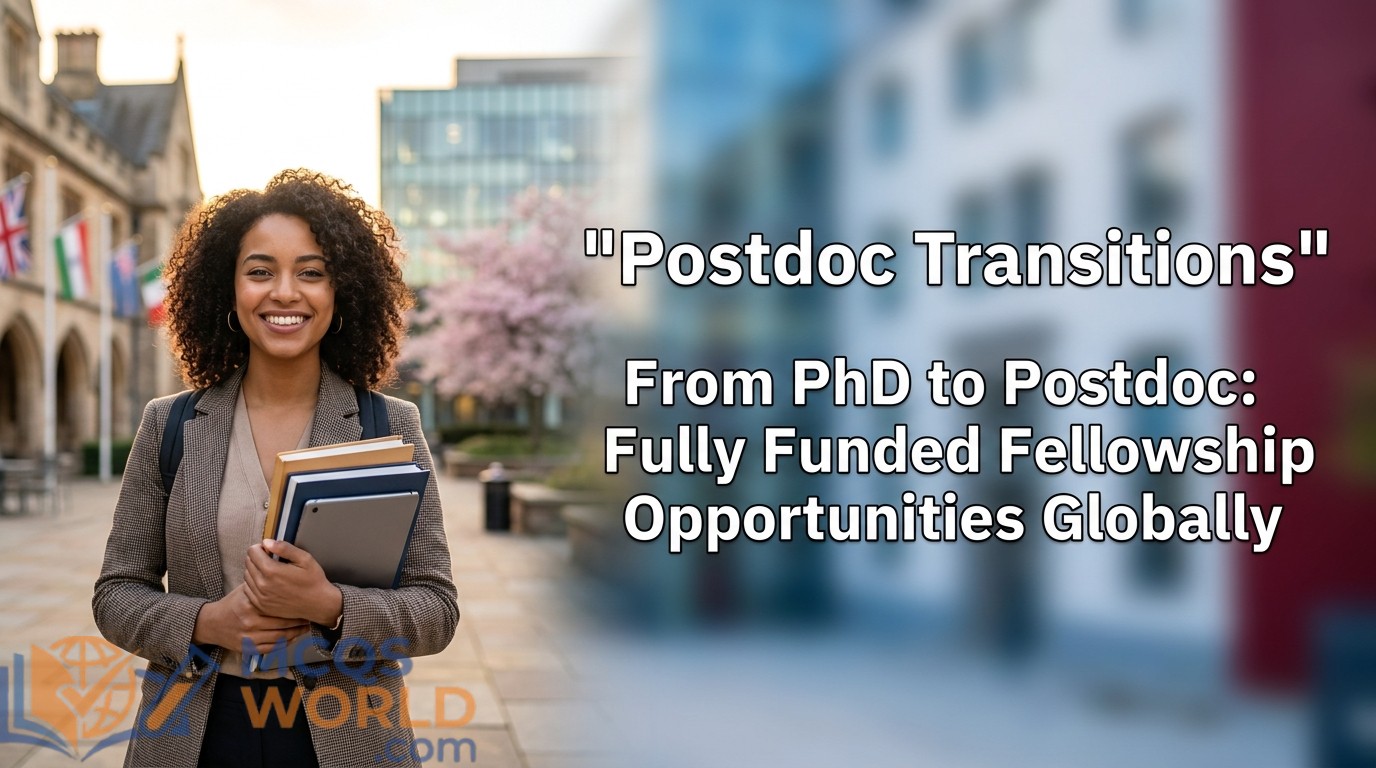
Finishing a PhD is a genuine milestone, but for most early-career researchers, it immediately raises a harder question: what comes next. The academic job market for permanent faculty positions remains tight almost everywhere, and a well-chosen postdoctoral fellowship has become less of an optional stepping stone and more of a near-necessary bridge between doctoral study and a stable research career.
The good news is that the postdoctoral funding landscape is genuinely global, with major fellowship programs in Europe, Germany, Japan, Canada, and beyond actively recruiting talented researchers regardless of nationality. The challenge is that each of these programs has its own eligibility rules, application mechanics, and funding structure, and treating them as interchangeable, or missing a critical eligibility detail, can cost you months of wasted preparation.
In this guide, you will learn:
- Why the postdoc transition has become such a pivotal, competitive stage in an academic career, and why timing and program choice matter more than ever
- A detailed breakdown of leading fully funded postdoctoral fellowship programs available to international researchers, including eligibility, financial coverage, and application processes
- The exact documents you need to prepare a strong postdoctoral fellowship application
- The most common mistakes PhD graduates make when applying for postdoc funding, and insider strategies to strengthen your candidacy
- Answers to the specific questions researchers ask most often about eligibility windows, host institution requirements, and combining fellowships with academic job searches
Whether you are finishing your PhD this year or planning your postdoc search twelve months out, this guide will help you navigate a genuinely international, but genuinely complex, funding landscape. As always, confirm current deadlines and award details directly on each program’s official page before applying, since postdoctoral fellowship cycles and eligibility rules are revised regularly, and some programs are discontinued or restructured with little advance notice.
Understanding the Concept: Why the Postdoc Transition Matters More Than Ever
The Postdoc as a Structured, Time-Limited Research Apprenticeship
A postdoctoral fellowship is a temporary, typically one-to-three-year research position intended for researchers who have recently completed a PhD, allowing them to develop an independent research profile, publish further, and build the track record needed for a permanent academic or research position. Unlike a PhD, where you work under close supervision toward a specific thesis, a postdoctoral fellowship is generally expected to demonstrate your capacity to lead your own research direction, even when working within a host institution’s broader research group.
Crucially, most prestigious postdoctoral fellowships are portable, meaning the funding follows the researcher rather than being tied permanently to one specific university position, and are awarded through national or international competitive processes rather than simply being an extension of your PhD supervisor’s existing grant. This portability is precisely what makes international postdoctoral mobility such a viable and common career strategy.
Why This Matters for International Researchers Right Now
Academic hiring committees increasingly view international postdoctoral experience, particularly through a competitive, externally funded fellowship, as a strong signal of independent research capability and global research network breadth. At the same time, many governments and research funders have deliberately built postdoctoral fellowship programs specifically to attract international talent, recognizing that domestic PhD graduates alone cannot fill their research capacity needs, which creates a genuinely favorable structural opportunity for well-prepared international applicants right now.
This favorable landscape is not static, however. Program eligibility rules, funding levels, and even entire schemes can shift with national research funding priorities and government budget cycles, as demonstrated by Canada’s own postdoctoral funding landscape, where the long-running Banting Postdoctoral Fellowships program was discontinued in early 2025 and replaced with a restructured Canada Postdoctoral Research Award. Staying current on exactly which programs are actively accepting applications, rather than relying on older articles describing a scheme that may no longer exist in its previous form, is essential.
Case Study: How Tomás Timed His Postdoc Search Strategically
Consider Tomás, who completed a PhD in materials science at a university in Portugal and began researching postdoctoral funding options roughly a year before his expected thesis defense. Rather than waiting until after graduation to start his search, he identified a potential host supervisor in Germany whose research closely matched his interests, began an early informal correspondence, and structured his timeline specifically around the Alexander von Humboldt Foundation’s rolling application system, which allowed him to apply even before his final thesis defense date, provided his doctorate would be completed within the required window.
By the time Tomás formally defended his thesis, his Humboldt Research Fellowship application was already well advanced, supported by a host professor who had committed to the collaboration months earlier. This early, deliberate timing meant he transitioned directly from his PhD viva into a fully funded postdoctoral position in Germany with almost no funding gap, a outcome that is achievable specifically because several major postdoctoral fellowship programs, including Humboldt’s, are structured around flexible starting dates and pre-defense applications rather than requiring a completed degree in hand before you can even begin the process.
Top Fully Funded Postdoctoral Fellowship Opportunities Globally
Below is a detailed breakdown of leading postdoctoral fellowship programs open to international researchers. As with any funding guide, confirm current deadlines and award terms directly on each program’s official page before applying, since cycles and figures are revised regularly.
1. Marie Skłodowska-Curie Actions (MSCA) Postdoctoral Fellowships
Overview: One of the largest and most prestigious postdoctoral funding schemes in the world, funded through the European Union’s Horizon Europe program, supporting researchers of any nationality to conduct a research project at a host institution in Europe, or through Global Fellowships, with an outgoing phase outside Europe followed by a return phase.
Eligibility: Applicants must hold a doctoral degree, or have successfully defended their thesis, by the call deadline, with no more than eight years of research experience since completing the PhD, excluding permitted exclusions such as parental leave. A mobility rule applies, generally requiring that you have not resided or worked in the host country for more than twelve months in the three years immediately prior to the deadline.
Financial Coverage: A living allowance, mobility allowance, and, where applicable, a family allowance, combining to a substantial monthly package that varies by host country cost of living, alongside a separate research, training, and networking cost contribution paid to the host institution.
Required Documents: A detailed research proposal developed jointly with your host supervisor and institution, a CV, and a letter of commitment from your host organization; an ethics self-assessment is required where relevant to your specific research.
Application Process: Identify a host institution and supervisor well ahead of the annual call, develop your proposal collaboratively, and submit through the European Commission’s Funding and Tenders Opportunities Portal before the published deadline, which has recently fallen in early September following an April call opening.
2. Alexander von Humboldt Research Fellowship (Germany)
Overview: A highly prestigious, discipline-independent fellowship enabling early-career and experienced international researchers to conduct self-designed research in Germany in collaboration with a host of their own choosing at a German research institution.
Eligibility: Applicants must hold a doctorate or comparable academic degree, generally completed no more than four years prior to application for the postdoctoral-level category, with a separate, more senior category available for experienced researchers further along in their careers. Applicants must freely choose a host professor or supervisor at a German institution who agrees to support the proposed research.
Financial Coverage: A monthly stipend, generally in the range of roughly €3,000 to €3,600 depending on career stage, plus additional financial support for accompanying family members, an intensive German language course prior to the fellowship, and structured alumni sponsorship after the research stay concludes.
Required Documents: A research proposal developed with your prospective host, academic references, degree certificates, and a CV; applications are submitted directly through the Alexander von Humboldt Foundation’s own online portal.
Application Process: Applications can generally be submitted at any time given the program’s rolling, flexible start-date structure, though you must first secure a host professor’s agreement to support your proposal before formally applying; begin this outreach process well ahead of your intended start date.
3. JSPS Postdoctoral Fellowships for Research in Japan
Overview: Administered by the Japan Society for the Promotion of Science, this program provides opportunities for postdoctoral researchers from eligible countries to conduct cooperative research under the guidance of a host researcher at a Japanese university or research institution, spanning all academic disciplines.
Eligibility: Applicants must be citizens or permanent residents of a country with diplomatic relations with Japan, and generally must have obtained their doctoral degree within roughly six years of the fellowship’s effective start date; a Japanese host researcher must agree in advance to supervise the applicant’s research.
Financial Coverage: A round-trip economy-class air ticket, a monthly maintenance allowance of approximately JPY 362,000 for PhD holders, a settling-in allowance for fellows with three or more months of tenure, and a separate research support allowance paid to the host institution to cover cooperative research expenses.
Required Documents: An application form completed by the candidate, a letter of acceptance from the prospective host researcher in Japan, and a letter of recommendation from the candidate’s doctoral supervisor, distinct from the Japan-based host.
Application Process: Unlike many fellowships, you do not apply independently; your prospective Japanese host researcher and their institution submit the application on your behalf through JSPS’s electronic application system, meaning your first concrete step is identifying and securing agreement from a suitable host researcher in Japan.
4. Canada Postdoctoral Research Award (Formerly the Banting Postdoctoral Fellowships)
Overview: Following the discontinuation of the long-running Banting Postdoctoral Fellowships program in early 2025, Canada’s federal tri-agency system, spanning the Canadian Institutes of Health Research, the Natural Sciences and Engineering Research Council, and the Social Sciences and Humanities Research Council, introduced the restructured Canada Postdoctoral Research Award (CPRA) as its current flagship postdoctoral funding mechanism.
Eligibility: Specific eligibility criteria for the CPRA differ somewhat from the previous Banting structure and continue to be refined; prospective applicants, including international candidates, should review the current NSERC, CIHR, or SSHRC program pages directly for up-to-date eligibility windows, degree-completion timing rules, and host institution requirements before beginning preparation.
Financial Coverage: Exact award values under the new CPRA structure should be confirmed directly on the current program page, since funding levels have been subject to revision as part of the broader tri-agency restructuring.
Required Documents: Expect a research proposal, CV, letters of reference, and host institution confirmation, broadly similar to the prior Banting program’s requirements, though applicants should verify the current CPRA-specific document list directly.
Application Process: You can apply to only one tri-agency postdoctoral program per academic year, and applications are generally submitted through ResearchNet in collaboration with a confirmed host institution; because this program has recently undergone significant restructuring, verify current deadlines and mechanics directly on the relevant granting agency’s website rather than relying on older Banting-specific guidance.
5. Fulbright Visiting Scholar and Postdoctoral Opportunities (United States)
Overview: Beyond its well-known Foreign Student Program for degree-seeking students, Fulbright also supports postdoctoral and visiting scholar research opportunities in the United States for international researchers, administered on a country-by-country basis similarly to the Foreign Student Program.
Eligibility: Eligibility, available research areas, and whether postdoctoral-level awards are offered at all vary significantly by country, similarly to the structural pattern seen in Fulbright’s degree-seeking programs; confirm directly with your country’s specific Fulbright Commission or U.S. Embassy whether postdoctoral or visiting scholar awards are currently available to you.
Financial Coverage: Typically includes a living stipend, health insurance, and often round-trip travel, with exact benefit levels varying by host city and specific country program terms.
Required Documents: A research or project statement, CV, letters of reference, and confirmation of an appropriate U.S. host institution or affiliation, depending on your specific country’s application structure.
Application Process: Apply through your country’s binational Fulbright Commission or U.S. Embassy, following the same decentralized, country-specific process that governs Fulbright’s degree-seeking programs; confirm your specific national deadline and whether a host affiliation must be secured before or after your initial application submission.
Required Documentation & Preparation Strategy
Across nearly every postdoctoral fellowship above, a broadly consistent documentation package recurs.
A Host Institution Agreement, Secured Early
Unlike most PhD funding, the overwhelming majority of prestigious postdoctoral fellowships require you to identify and secure agreement from a specific host supervisor and institution before, or as part of, your formal application. Begin this outreach process many months in advance, since securing a strong host commitment is often the single longest lead-time item in your entire application timeline.
A Tailored Research Proposal
Your proposal should demonstrate a clear, independent research direction that builds meaningfully on your PhD work while showing genuine potential to grow beyond it, developed collaboratively with your prospective host rather than presented as an entirely fixed, non-negotiable plan.
Academic Transcripts and Degree Certificates
Provide certified copies of your doctoral degree certificate, or confirmation of your successful thesis defense if your degree has not yet been formally conferred, since several major fellowships, including MSCA, explicitly accept candidates who have defended but not yet formally received their degree certificate.
Letters of Recommendation
Most postdoctoral fellowships require two to three references, ideally including your PhD supervisor and at least one additional academic reference who can speak to your independent research trajectory and readiness for a self-directed postdoctoral project.
Evidence of Research Output
Present your publication record, conference presentations, and any awards prominently, since postdoctoral fellowship panels weigh demonstrated research productivity and independence considerably more heavily than PhD-level funding panels typically do.
Common Mistakes to Avoid & Insider Tips
Mistake 1: Waiting until after your PhD defense to begin your postdoc search. Many of the strongest fellowships, including Humboldt and MSCA, allow or even expect early outreach and application well before your defense date. Starting your search a year in advance, as in Tomás’s case study above, meaningfully reduces or eliminates funding gaps.
Mistake 2: Assuming a program’s previous structure still applies. As Canada’s Banting-to-CPRA transition demonstrates, major postdoctoral programs can be discontinued or substantially restructured with limited notice. Always verify a program’s current status directly before building your application timeline around it.
Mistake 3: Underestimating how long securing a host commitment takes. Because most prestigious fellowships require a confirmed host supervisor before or during application, and strong hosts are often approached by multiple prospective postdocs simultaneously, begin this outreach far earlier than you might for a standard job application.
Mistake 4: Submitting a research proposal indistinguishable from your PhD thesis. Postdoctoral fellowship panels specifically look for evidence of independent intellectual growth beyond your doctoral work, not a direct continuation presented without a clear new contribution.
Mistake 5: Overlooking country-specific eligibility windows tied to your PhD completion date. Several fellowships, including JSPS and Humboldt, impose strict limits on how many years may have elapsed since your doctorate was awarded; confirm this window precisely rather than assuming general eligibility.
Insider tip: For fellowships requiring a host institution agreement, approach potential hosts with a short, specific research proposal outline rather than a vague expression of general interest, since a concrete starting point makes it far easier for a busy potential host to say yes quickly.
Insider tip: Apply to more than one country’s postdoctoral fellowship system simultaneously where your eligibility allows, since this diversifies your risk against any single program’s funding cycle, budget change, or unexpected discontinuation.
Insider tip: Join the relevant fellowship’s alumni network, such as the Marie Curie Alumni Association or JSPS’s alumni association, even informally through public event listings, since these networks frequently share genuinely current, ground-level insight into each program’s evolving priorities and selection tendencies.
Comprehensive FAQ Section
Can I apply for a postdoctoral fellowship before I have formally received my PhD degree certificate?
Yes, in many cases; several major fellowships, including MSCA, explicitly accept candidates who have successfully defended their thesis but not yet formally received their degree certificate, provided this is completed by the stated deadline, so confirm the exact requirement for your target program rather than assuming you must already hold the physical certificate.
Do I need to have already identified a specific host supervisor before applying?
For most of the fellowships in this guide, yes; unlike many PhD funding schemes, prestigious postdoctoral fellowships typically require a confirmed host institution and supervisor as part of, or prior to, your formal application, making early outreach one of the most important preparation steps.
Is the Banting Postdoctoral Fellowship still available in Canada?
No; the Banting Postdoctoral Fellowships program was discontinued as of February 2025 and has been replaced by the restructured Canada Postdoctoral Research Award under Canada’s tri-agency system, so applicants should reference current CPRA program pages rather than older Banting-specific guidance.
How many years after completing my PhD can I still apply for these postdoctoral fellowships?
This varies significantly by program; MSCA generally allows up to eight years of post-PhD research experience with certain permitted exclusions, while Humboldt’s standard postdoctoral category and JSPS both generally apply a roughly four-to-six-year window, so confirm your specific target program’s exact eligibility window directly.
Can I hold a postdoctoral fellowship in a different field from my PhD?
Many programs do permit some degree of field flexibility, particularly where a genuine, well-argued interdisciplinary connection exists, though you will generally need a host supervisor and institution willing to support a project outside your exact prior specialization, so this is best confirmed directly with your prospective host and the specific program’s guidelines.
Do postdoctoral fellowships allow me to bring family members?
Several major programs, including Humboldt, provide additional financial support for accompanying family members and language training for spouses, though the exact provisions vary considerably by program, so review each specific fellowship’s family support terms before finalizing your decision.
Is it possible to combine a postdoctoral fellowship with an active academic job search?
Yes, and this is common practice; most postdoctoral fellows continue building their publication record and applying for permanent academic positions throughout their fellowship period, with the fellowship itself often strengthening rather than distracting from that ongoing job search.
Conclusion & Next Steps
The transition from PhD to postdoc is one of the most consequential stages of an academic career, and the good news is that genuinely global, well-funded fellowship opportunities exist for researchers willing to plan ahead and navigate each program’s specific requirements carefully. Securing a host institution commitment early, tailoring your proposal to demonstrate genuine independent growth beyond your thesis, and diversifying your applications across more than one country’s system are the strategies that consistently separate successful transitions from prolonged funding gaps.
Start today by identifying two or three postdoctoral fellowship programs that align with your specific research direction and career goals, and begin reaching out to potential host supervisors well before your thesis defense date. Bookmark this page as you track each program’s current status and requirements, and explore our other resources on mcqsworld.com for further guidance on research proposal writing, cold-emailing potential supervisors, and building a complete, competitive funded academic career pathway.