



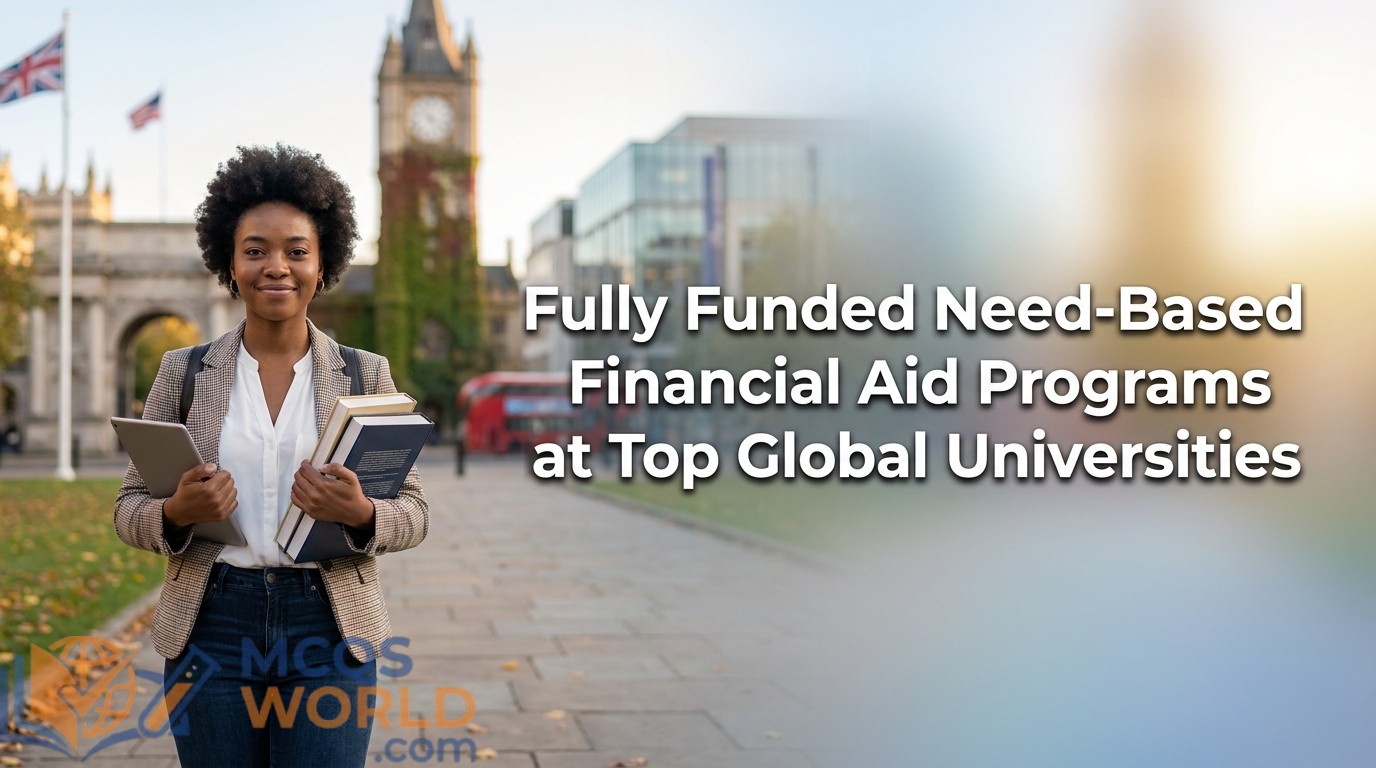
Somewhere between the acceptance letter you’re dreaming about and the tuition bill that could rival a mortgage sits a question that quietly ends more international ambitions than low grades ever do: who is actually going to pay for this?
Here’s the uncomfortable truth most guidance counselors won’t spell out clearly enough: the vast majority of universities, even world-famous ones, are “need-aware” for international applicants. That means your family’s bank balance can and does influence whether you get in, because international students generally can’t touch government-funded aid like U.S. federal grants or Canadian provincial loans. But a small, specific group of universities has broken from that pattern entirely. These institutions evaluate your application on merit alone and then commit, in writing, to covering the entire gap between what you can pay and what your education actually costs — no loans required in many cases.
This guide is built around that small, powerful group of programs. You’ll learn exactly which universities in the U.S., U.K., and Canada offer genuinely need-based, fully funded aid to international undergraduates; how “need-blind” differs from merely “generous”; the precise documents you’ll need to prove your financial need convincingly; the mistakes that quietly disqualify strong applicants; and answers to the very specific questions families ask once they realize this path is real. If you’ve assumed a world-class education is financially out of reach because of where you were born, this is the guide that should change your calculus.
What “Fully Funded Need-Based Aid” Actually Means — And Why the Distinction Matters Right Now
Need-based financial aid is calculated using a simple but consequential formula: Demonstrated Financial Need = Total Cost of Attendance − Expected Family Contribution. A university that “meets full demonstrated need” promises to close that entire gap through grants, work-study, or scholarships — not through debt you’ll be repaying for a decade after graduation. This is fundamentally different from a merit scholarship, which rewards achievement regardless of whether you can afford tuition, and it’s different again from a partial bursary, which might cover a portion of costs but still leave a painful shortfall.
The critical distinction for international students is between need-blind and need-aware admissions. A need-blind university evaluates your application — your grades, essays, extracurriculars, and recommendations — without ever looking at whether you’ve requested financial aid or how much you’d need. A need-aware university, by contrast, factors your ability to pay into the admissions decision itself, meaning two equally qualified applicants can receive different outcomes purely because one needs a $60,000 annual grant and the other doesn’t. Because international students cannot access most domestic government aid programs, colleges must fund their financial aid entirely from institutional endowments and donor gifts — which is precisely why so few schools can afford to be both need-blind and full-need for non-citizens.
This distinction matters enormously in 2026 because the landscape is actively shifting. Several institutions have recently expanded need-blind admissions to international applicants for the first time, while others have publicly announced future expansions tied to endowment growth. Understanding exactly which universities currently offer this — versus which merely say they’re “committed to affordability” — is the difference between building a realistic college list and wasting your application fees.
Illustrative case study: Picture a hypothetical student, Daniyar, from a middle-income family in Kazakhstan with strong grades but no ability to pay $90,000 a year in U.S. tuition and living costs. If Daniyar applies broadly to need-aware universities requesting a large aid package, he may face rejection at several despite strong academics, simply because his need competes against wealthier applicants for a limited aid budget. If instead he targets a need-blind, full-need institution — say, one of the small handful of U.S. universities on this list, or Oxford’s Reach Oxford Scholarship track for students from developing economies — his financial need becomes irrelevant to the admissions decision itself, and his academic profile is what determines the outcome. The strategic lesson: your target list should be built around aid policy, not just prestige rankings.
The Core List: Where Fully Funded Need-Based Aid Actually Exists for International Students
1. Harvard University (United States)
Overview: Harvard is need-blind for all applicants, domestic and international, and commits to meeting 100% of demonstrated financial need through grants rather than loans.
Financial Coverage: Families earning under roughly $85,000–$100,000 annually typically pay nothing toward tuition, room, or board. Families earning up to about $150,000–$200,000 typically pay a small percentage of income, and meaningful aid extends even further up the income scale. Coverage includes tuition, housing, meals, and often a startup allowance for books and personal costs.
Eligibility Criteria: Any admitted undergraduate applicant, regardless of citizenship, who submits the required financial aid forms.
Required Documents: CSS Profile, non-custodial parent forms if applicable, translated tax documents or income statements (since most international families won’t have a U.S. tax return), and supporting documentation of assets and family circumstances.
Step-by-Step Application Process:
- Apply for undergraduate admission through the Common Application by the relevant early or regular deadline.
- Submit the CSS Profile by the same deadline as your admissions application — Harvard uses this to calculate your family contribution.
- Provide supplementary income documentation specific to your country, since Harvard’s financial aid office works with families who don’t file U.S.-style tax returns.
- Await your aid package alongside your admissions decision; aid offers at need-blind schools arrive at the same time as (and are unaffected by) the admissions decision itself.
2. Yale University (United States)
Overview: Yale was among the first private research universities to commit to need-blind admissions and full-need financial aid, and it extends both policies to international applicants.
Financial Coverage: Families earning below roughly $75,000 typically pay nothing; aid packages are grant-based, allowing many students to graduate debt-free. Yale also provides travel funding for international students receiving significant aid, recognizing that airfare is a real and recurring cost these families face.
Eligibility Criteria: Open to all admitted undergraduates worldwide; no citizenship restriction on either admissions or aid eligibility.
Required Documents: CSS Profile, an international student certification of finances, translated financial documentation, and — depending on family structure — non-custodial parent statements.
Application Process: Mirrors Harvard’s: apply via Common Application, submit CSS Profile by the admissions deadline, and provide any supplementary financial documentation Yale’s office requests during verification.
3. Princeton University (United States)
Overview: Princeton is need-blind for all applicants and was the first U.S. university to eliminate loans entirely from its aid packages, replacing them with grants that never require repayment.
Financial Coverage: Princeton’s aid packages are described as covering close to 100% of tuition and a substantial share of living costs for recipients, with additional funding available for books, travel, and personal expenses. A large majority of recent graduating classes have left debt-free.
Eligibility Criteria: Any admitted undergraduate, regardless of nationality; there are no merit scholarships at Princeton, so all institutional aid flows through the need-based system.
Required Documents: CSS Profile, IDOC (Institutional Documentation Service) submission of tax or income equivalents, and non-custodial parent information where relevant.
Application Process: Submit your Common Application, complete the CSS Profile by the stated deadline, and follow up promptly with any documentation requests from Princeton’s financial aid office — international file verification can take longer than domestic verification, so early submission matters.
4. Massachusetts Institute of Technology (United States)
Overview: MIT is one of the few STEM-focused institutions that is need-blind for all applicants, including international students, and meets full demonstrated need.
Financial Coverage: Aid is calculated through a thorough, individualized review of family circumstances rather than a fixed formula, and packages are described by the university as generous relative to actual cost of attendance, covering tuition, housing, and meals for the vast majority of aided students.
Eligibility Criteria: Open to international applicants without restriction; particularly relevant for students applying to engineering, computer science, and physical sciences programs.
Required Documents: CSS Profile, MIT’s own supplementary financial aid application, and income documentation translated and converted to USD.
Application Process: Apply through MIT’s own application system (not solely the Common App), submit financial aid forms by the specified deadline — historically earlier than many peer institutions — and respond quickly to verification requests given MIT’s smaller international aid office relative to application volume.
5. Amherst College (United States)
Overview: A highly selective liberal arts college, Amherst is need-blind for all applicants — domestic, international, and undocumented — and meets 100% of calculated need for admitted students who apply for aid.
Financial Coverage: Amherst’s own admissions materials state explicitly that financial situation “has no bearing” on admission decisions, and the college commits to covering the full calculated difference between cost of attendance and family contribution.
Eligibility Criteria: Any admitted student regardless of citizenship or immigration status.
Required Documents: CSS Profile, non-U.S. tax document equivalents, and any supplementary forms Amherst’s aid office requests for international applicants specifically.
Application Process: Apply via the Common Application, submit the CSS Profile by the admissions deadline, and provide documentation promptly since Amherst’s smaller class size means aid decisions are finalized on a tighter internal timeline.
6. Dartmouth College, Bowdoin College, Notre Dame, Brown University, and Washington and Lee University (United States)
Overview: This cluster of institutions has each independently extended need-blind admissions and full-need aid to international applicants in recent admissions cycles, joining the smaller historical group above. Policies and starting classes vary by school, so always verify the current-year policy directly on the university’s own financial aid page before applying, since these commitments are relatively new and sometimes phased in by entering class year.
Financial Coverage: Each commits to meeting 100% of demonstrated need through grant aid, though the specific mix of grants versus limited work-study can differ by institution — Bowdoin and Washington and Lee, for instance, both emphasize no-loan aid packages, while Notre Dame notes that students who also qualify for merit scholarships may see their need-based award adjusted accordingly under federal and institutional rules.
Required Documents: Generally the CSS Profile plus school-specific international student financial forms; some schools also request bank statements or sponsor letters as part of visa-related documentation later in the admissions cycle.
Application Process: As with the schools above, timing is everything — submit the CSS Profile the same day you submit your admissions application, don’t wait for an acceptance before starting the financial aid process, and check each school’s official page for the exact class year its international need-blind policy applies to, since some of these commitments (Brown and Notre Dame among them) only recently took effect and may not cover every applicant cohort yet.
7. Reach Oxford Scholarship, University of Oxford (United Kingdom)
Overview: Unlike the U.S. universities above, Oxford does not offer blanket need-blind admissions or full-need aid to all international undergraduates — UK financial aid for internationals is generally far more limited than in the U.S. However, Oxford’s Reach Oxford Scholarship is a genuine fully funded, need-based program specifically targeting students from lower-income backgrounds in developing countries.
Financial Coverage: The scholarship covers full tuition fees, college and living costs, and return airfare for the duration of an undergraduate degree — a true full-ride structure rather than a partial bursary.
Eligibility Criteria: Applicants must typically be nationals of and resident in an eligible developing country, demonstrate genuine financial need that would otherwise prevent them from studying at Oxford, and meet Oxford’s standard rigorous academic admissions requirements for their chosen course.
Required Documents: Standard UCAS undergraduate application materials, Oxford’s own supplementary application forms, evidence of financial circumstances (often via a designated referee or in-country partner organization Oxford works with), and academic transcripts translated into English.
Application Process: Apply for undergraduate admission through UCAS by the UK’s international deadline (typically mid-October for Oxford), simultaneously submit the Reach Oxford Scholarship application through the specific channel Oxford designates for eligible countries, and stay in close contact with your school counselor, since Oxford often coordinates with in-country partner organizations to identify and verify eligible candidates.
8. Need-Based Entrance Awards at Canadian Universities: UBC and York University
Overview: Canada’s public universities generally cannot offer the same scale of need-based aid to international students that elite U.S. private universities can, since public funding is restricted to citizens and permanent residents. However, a handful of need-based, high-value international awards exist at specific institutions and are worth targeting directly.
Financial Coverage: York University’s international entrance scholarship for students applying directly from high school can be worth roughly $140,000 total across four years of study, contingent on maintaining strong academic standing. The University of British Columbia’s International Major Entrance Scholarships offer a smaller but still meaningful $10,000–$20,000 per year for exceptional incoming international undergraduates.
Eligibility Criteria: Both require the applicant to hold (or require) a Canadian study permit, apply as an incoming international undergraduate directly from secondary school in most cases, and demonstrate outstanding academic achievement alongside evidence of leadership or extracurricular excellence; York’s award additionally requires no prior post-secondary study.
Required Documents: Standard undergraduate application through the relevant provincial application portal, secondary school transcripts, and any supplementary scholarship-specific application forms the university’s international office requires — these are generally evaluated automatically from your admissions file rather than through a separate long-form scholarship essay.
Application Process: Apply for undergraduate admission to your chosen program by the priority deadline, ensure your application clearly indicates your status as an international student requiring a study permit, and check the university’s international scholarships page directly, since automatic consideration timelines and required supplementary forms vary by institution and by year.
Required Documentation & Preparation Strategy
Every one of these programs relies on you proving your financial circumstances clearly and credibly, and international families consistently stumble on the same set of documents.
The CSS Profile. Nearly every U.S. need-based aid program listed above requires the College Scholarship Service Profile, a far more detailed financial disclosure than the FAFSA (which international students generally cannot file at all). The CSS Profile asks about foreign income, non-U.S. retirement accounts, home equity, and business ownership in formats that don’t map cleanly onto every country’s financial system — start this well before your admissions deadline, since the CSS Profile itself is typically due the same day as your application, not after you’re admitted.
Translated and converted income documentation. Since most international families won’t have a U.S. tax return, universities typically request the closest equivalent your country produces (a tax assessment, employer salary certificate, or notarized income statement), translated into English and converted to USD at a stated exchange rate. Have a certified translator handle this rather than a casual translation, since financial aid offices scrutinize these documents closely during verification.
Non-custodial parent documentation. If your parents are divorced, separated, or one parent is deceased or absent, most CSS Profile schools still require financial information from both biological parents unless a formal waiver is granted. Request this documentation early, since gathering it from an estranged or hard-to-reach parent is consistently one of the most time-consuming steps in the entire process.
Proof-of-funds documentation for visa purposes. Separate from the university’s own aid process, your eventual F-1 (U.S.), Tier 4/Student Route (UK), or study permit (Canada) application will require its own proof-of-funds documentation once you’re admitted and your aid package is finalized. Keep your official aid award letter — clearly showing amount, duration, and renewal conditions — ready to submit alongside any remaining personal or sponsor funding evidence.
A clear, honest financial narrative. Many of these applications include a short statement or interview component where you can contextualize your family’s financial situation — currency instability, regional cost-of-living differences, or an unusual income structure. Use this space factually and specifically rather than vaguely; admissions and aid officers read hundreds of these and respond better to concrete detail than to generalized hardship language.
Common Mistakes to Avoid & Insider Tips
Mistake 1: Assuming a famous, wealthy university automatically means generous international aid. Many highly ranked universities — Stanford and most Ivy League schools outside the group above included — are need-aware for international applicants, meaning your aid request can influence your admission outcome. Research each target school’s specific international aid policy rather than assuming prestige equals affordability.
Mistake 2: Submitting the CSS Profile after the admissions deadline. At need-blind, full-need schools, your financial aid forms are typically due the same day as your application, not afterward. Missing this deadline can delay or jeopardize your aid consideration even if your admission itself isn’t affected.
Mistake 3: Underestimating how long international document verification takes. Financial aid offices frequently need extra time to verify foreign income documentation, translated tax records, or currency conversions. Submit every document weeks ahead of the stated deadline rather than on the exact due date.
Mistake 4: Ignoring non-U.S. options entirely. Families fixate on the small U.S. need-blind list and overlook genuinely fully funded programs like Oxford’s Reach Oxford Scholarship or Canada’s larger entrance awards, both of which have smaller applicant pools and correspondingly better odds for well-qualified candidates.
Mistake 5: Treating “meets full demonstrated need” as identical across every school. Each institution calculates “demonstrated need” using its own formula and its own definition of reasonable family contribution, meaning your award can vary significantly between schools with seemingly identical policies. Always run your numbers through each university’s own net price calculator rather than assuming parity.
Insider Secret: Contact each university’s international financial aid counselor directly, by name if possible, well before you apply. These offices see far fewer international aid inquiries than domestic ones and are often unusually responsive to specific, well-researched questions — particularly about how they’ll interpret unconventional income situations like self-employment, agricultural income, or currency controls in your home country.
Comprehensive FAQ Section
Can I still apply for need-based aid if my family’s income doesn’t fit neatly into a standard tax return format?
Yes. Universities using the CSS Profile expect this and typically request the closest available equivalent — a government tax assessment, an employer letter, or a notarized income declaration — rather than requiring a literal U.S.-style tax return. Contact the financial aid office directly if your country’s documentation doesn’t map onto the CSS Profile’s standard categories.
Does requesting a large financial aid package hurt my chances at a need-aware university, even if I’m a strong applicant?
Potentially, yes. At need-aware institutions, your aid request can be weighed against a limited international aid budget, meaning it’s genuinely possible for a less financially needy applicant with a similar profile to be favored. This is precisely why targeting the need-blind institutions listed here is a meaningfully different strategy than applying broadly and hoping for the best.
Is need-based aid available for transfer students, or only first-year applicants?
It varies by institution. Several of the schools above extend the same need-blind, full-need policy to transfer applicants, while others — including some Canadian entrance awards — are explicitly restricted to students applying directly from secondary school with no prior post-secondary study. Always check the specific eligibility language for transfer applicants before assuming the policy applies to you.
Can I combine a need-based aid package with an external scholarship without losing aid?
Often yes, but not always dollar-for-dollar. Some universities reduce your institutional grant when you bring in outside scholarship money above a certain threshold, while others allow you to use external awards to replace a work-study or loan component of your package first. Ask the financial aid office in writing exactly how external scholarships interact with your specific award before accepting outside funding.
What happens to my aid if my family’s financial situation changes during my degree?
Reputable need-based programs re-evaluate your aid annually based on updated financial documentation, meaning your award can increase if your family’s circumstances worsen, or decrease if they improve. If a sudden hardship occurs mid-year — a job loss, currency crisis, or medical emergency — contact your aid office immediately, since most schools have an appeals or emergency reassessment process outside the normal annual cycle.
Are graduate students eligible for these same need-based programs?
Generally no — most of the programs listed here are specifically undergraduate policies. Graduate funding, particularly in the U.K. (such as the Gates Cambridge Scholarship) and at the PhD level generally in the U.S., typically runs through separate, often more merit-and-research-focused funding structures rather than the family-income-based need calculation used for undergraduates.
Do I need perfect grades to be competitive for these programs, given how selective they already are?
These universities are highly selective on academics independent of their aid policy, so a genuinely strong academic record is a prerequisite, not a formality. That said, “perfect” is not the bar — a consistently strong, upward-trending academic record combined with meaningful extracurricular depth and a well-articulated personal narrative is generally what distinguishes admitted, fully-funded international students from the broader applicant pool.
Conclusion & Next Steps
The ultimate takeaway here is simple but easy to miss: a small, specific group of universities has deliberately built its admissions and financial aid systems so that a student’s ability to pay never determines whether they get a world-class education. Harvard, Yale, Princeton, MIT, Amherst, and a growing cluster of peer institutions in the U.S., alongside targeted programs like Oxford’s Reach Oxford Scholarship and Canada’s larger international entrance awards, prove that fully funded, need-based aid for international students isn’t a myth — it’s a specific, researchable, applicable reality.
Your next step is straightforward: build your college list around aid policy first and prestige second, start your CSS Profile and financial documentation months before any deadline, and reach out directly to international financial aid counselors at every school on your shortlist. Bookmark this guide to revisit as deadlines approach, and keep checking mcqsworld.com for deeper dives into each step of the international funding process. The students who secure these life-changing aid packages aren’t the ones who assumed they couldn’t afford it — they’re the ones who researched exactly where the money actually is, and applied. Start building that list today.