



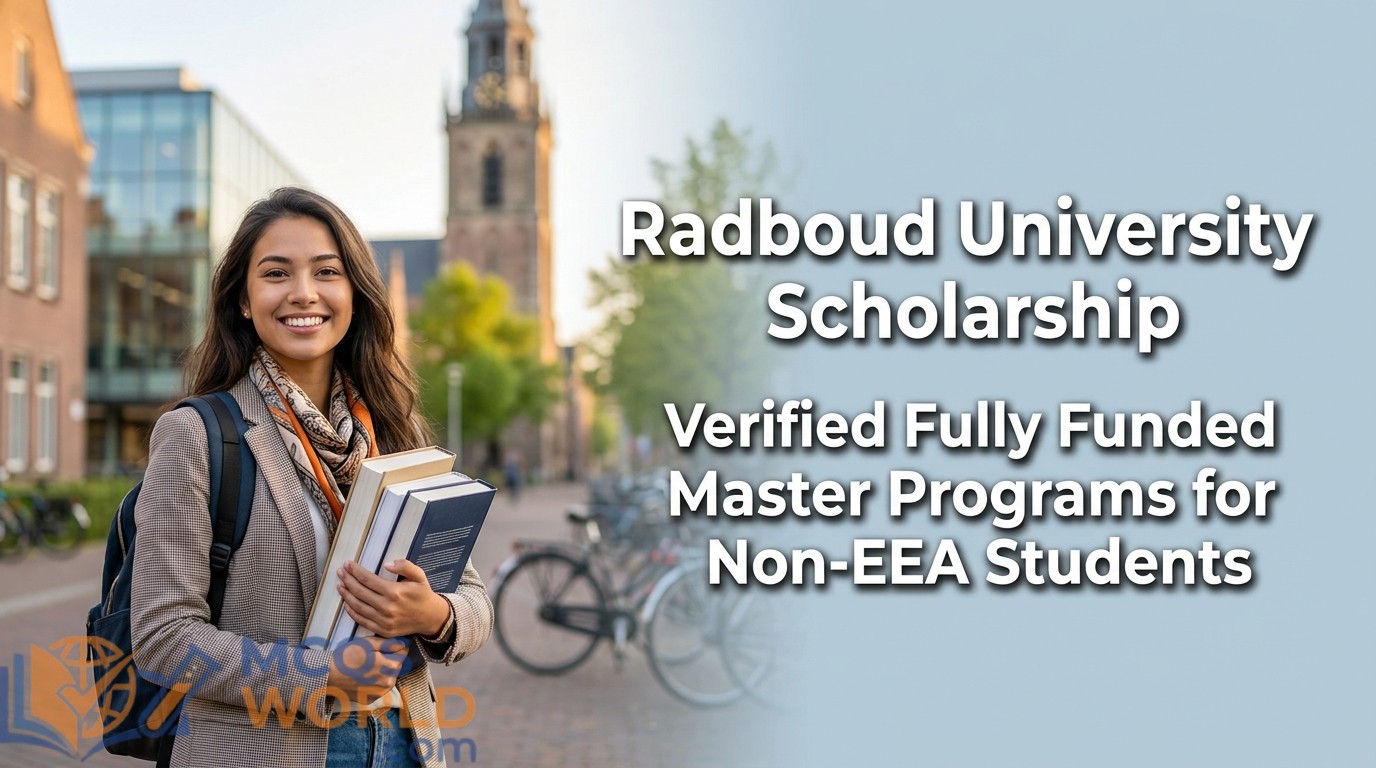
Before anything else, a correction worth making plainly: the Radboud Scholarship Programme is not a fully funded scholarship, whatever a given search result might call it. Radboud University’s own page states it directly — the award reduces your tuition fee to €2,694 for the year, down from a non-EEA rate that can run around €18,000 depending on your program, and it does not cover your living or study costs at all. That’s a substantial reduction, genuinely worth applying for, but it’s not “free,” and treating it as such can leave you badly underprepared for the actual cost of living in the Netherlands.
There’s also a structural detail worth knowing before you dive into eligibility: Radboud runs at least three separate, related scholarships — the Radboud Scholarship Programme, the Radboud Encouragement Scholarship, and the NL Scholarship — with different funding levels, different eligible faculties, and different combination rules. This guide focuses on the Radboud Scholarship Programme specifically, since that’s the one most commonly searched, but flags where the other two come in so you don’t confuse them.
Why This Scholarship Matters
Radboud University, based in Nijmegen, is a research-intensive Dutch university with a strong international reputation, particularly across the humanities, law, management, philosophy and theology, natural sciences, and social sciences. For a non-EEA student, the tuition gap between EEA and non-EEA rates in the Netherlands is large enough that even a partial reduction changes the practical calculus of whether a program is affordable.
What makes the Radboud Scholarship Programme worth serious attention despite being partial is the scale of the reduction itself: cutting tuition from roughly €18,000 down to €2,694 is closer to a 85% cut than a token discount, and it’s paired with coverage for visa, residence permit, health insurance, and liability insurance costs that would otherwise add up on their own. Treated honestly — as a large tuition discount plus insurance coverage, not as free tuition and living costs — it’s a genuinely strong piece of a funding strategy for the right applicant, especially combined with other funding sources for daily living expenses.
Quick Reference Table
| Detail | Information |
| Program name | Radboud Scholarship Programme (distinct from the Radboud Encouragement Scholarship and NL Scholarship) |
| Award type | Partial tuition reduction — not fully funded |
| Tuition after award | Reduced to €2,694 for the year (from up to roughly €18,000, depending on program) |
| Other costs covered | Visa, residence permit, health insurance, and liability insurance (via Aon Student Insurance) |
| Not covered | Living costs and general study expenses in the Netherlands |
| Number of awards (2026-27) | Maximum of 33, distributed across specific faculties |
| Eligible faculties | Faculty of Arts (4), Faculty of Law (4), Nijmegen School of Management (6), Faculty of Philosophy, Theology and Religious Studies (3), Faculty of Science (8), Faculty of Social Sciences (8) |
| Excluded programs | Erasmus Mundus Master’s programs and joint-degree Master’s programs |
| Application platform | OSIRIS Application system, alongside your master’s application |
| Initial submission deadline | 31 January, 23:59 CET |
| Final complete-application deadline | 14 February, 23:59 CET |
| Decision announced | Before mid-April (date subject to change) |
Who Actually Qualifies
Non-EEA passport holders, ineligible for lower EU/EEA tuition rates. This is the foundational nationality requirement — you need to be outside the EU/EEA and not otherwise entitled to the reduced EU/EEA tuition fee for any reason.
Students whose entire education has taken place outside the Netherlands. You need to hold, or be close to obtaining, a bachelor’s degree earned outside the Netherlands, with no degrees earned in the Netherlands and no prior Dutch education — with one specific exception: exchange programs are excluded from this rule, provided they were part of a bachelor’s degree you completed abroad.
Applicants who meet the English proficiency requirement for their specific program. This isn’t a fixed university-wide test score — it’s whatever English proficiency standard your chosen master’s program itself requires, so check your specific program’s page rather than assuming a blanket threshold applies.
Students who have already secured full admission, not just applied. Critically, you need to have been fully admitted to your English-taught master’s program, as confirmed in a formal letter of admission, for a 1 September start — a pending or provisional application isn’t sufficient for scholarship consideration.
Applicants able to meet Dutch visa requirements and commit to full-time enrollment. You need to be able to satisfy the conditions for obtaining a Dutch visa, and you need to enroll as a full-time student at Radboud for the specific academic year and program the scholarship covers.
How the Application Actually Works
Step 1: Apply for admission to an eligible master’s program through OSIRIS. The Radboud Scholarship Programme application isn’t a separate system — it’s an option you select within your regular master’s admission application in the OSIRIS Application system.
Step 2: Indicate during that application that you want to apply for the Radboud Scholarship. This is a checkbox-style step within the same process, not a distinct portal.
Step 3: Upload three additional documents. Beyond your standard master’s application materials, the scholarship specifically requires two reference letters and a CV. If you already uploaded a CV or reference letters as part of your master’s application, you can reuse those same documents for the scholarship application rather than preparing entirely new ones.
Step 4: Submit your initial application by 31 January, 23:59 CET. This is the first hard deadline — miss it, and there’s no scholarship consideration for that cycle.
Step 5: Respond to the Admissions Office’s review. After your initial submission, Radboud’s Student Admissions office checks your OSIRIS application and sends it back to you if anything is incorrect, illegible, or missing, along with a request for the handling fee payment.
Step 6: Ensure everything is complete by 14 February, 23:59 CET. This second, later deadline is for your fully corrected and complete application — incomplete applications at this stage are explicitly excluded from scholarship selection, so treat this as the real final deadline, not the January date.
Step 7: Submit English proficiency proof early. Radboud specifically recommends handing in your English proficiency documentation before the 14 February deadline, rather than waiting until the last moment.
Step 8: Wait for the decision, expected before mid-April. Notification comes from the department Student Life and International Mobility, and Radboud notes this date is subject to change, so don’t build firm plans around a specific day within that window.
Eligibility Details and the Two Related Scholarships Worth Knowing About
Admission and scholarship selection are genuinely separate decisions. Being admitted to your master’s program doesn’t automatically mean you’re being considered for, let alone awarded, the scholarship — these run as two distinct evaluation processes, and Radboud states this explicitly.
Second-year continuation isn’t automatic for two-year programs. If you’re admitted to a two-year master’s and awarded the scholarship, you need to pass all first-year courses to retain the award into your second year — it’s not simply awarded once for the full program duration regardless of performance.
You generally can’t combine this with some other Radboud scholarships, but can combine it with one specific one. The Radboud Scholarship Programme cannot be combined with the Radboud Encouragement Scholarship or the Fulbright-Radboud Scholarship — you can apply for more than one, but only one will actually be granted. It can, however, be combined with the separate NL Scholarship (formerly known as the Holland Scholarship), and in fact, applying for the NL Scholarship at Radboud specifically requires that you’ve also applied for the Radboud Scholarship Programme in the same cycle.
The Radboud Encouragement Scholarship is a different, more generous program aimed at a different purpose. Where the Radboud Scholarship Programme is explicitly merit-focused and partial, the Encouragement Scholarship is framed around supporting talented students facing genuine financial hardship, and in past cycles has covered full tuition plus a living-cost allowance (referencing the IND’s official cost-of-living figure) rather than just a tuition reduction. It also draws from a different, though overlapping, set of eligible faculties. If your circumstances involve real financial need rather than just strong academics, it’s worth checking this program’s own separate eligibility criteria rather than assuming the standard Radboud Scholarship Programme is your only route.
The NL Scholarship is smaller, shorter, and structurally different again. It’s worth €5,000, awarded for one year only, and can only be received once — it’s co-financed by the Dutch Ministry of Education, Culture and Science alongside Radboud University, and it has its own separate faculty allocation and award count, distinct from both of the other two programs.
Avoiding Scams and Misinformation
Because “fully funded” is such a searched phrase, and because Radboud runs multiple similarly named scholarships, this space has real potential for confusion — some of it from careless content, not necessarily malicious intent. A few things worth checking directly:
Be skeptical of any source calling the Radboud Scholarship Programme “fully funded.” As established above, Radboud’s own page is explicit that this is a partial tuition reduction with living costs excluded. If a source claims full funding, complete tuition coverage, or doesn’t mention the €2,694 remaining tuition figure at all, treat that as a sign the content hasn’t been checked against the university’s own page.
There’s no separate scholarship application portal outside OSIRIS. The entire process runs through the same system as your master’s application. Any site directing you to a distinct “Radboud Scholarship” application form separate from OSIRIS doesn’t match how the real process works.
No fee is charged specifically for scholarship consideration, beyond the standard handling fee tied to your OSIRIS application processing generally. Be wary of any request for a distinct payment framed as a scholarship processing or guarantee fee.
Don’t confuse the three Radboud scholarships when checking figures online. Because the Radboud Scholarship Programme, the Radboud Encouragement Scholarship, and the NL Scholarship have different amounts and different eligible faculties, a source quoting one program’s figures while discussing another by name is a sign of sloppy aggregation, not necessarily deliberate fraud — but it still means you shouldn’t trust the specific numbers without checking the correct scholarship’s own official page.
Confirm current-cycle deadlines and faculty allocations directly on ru.nl. Both the number of awards and their distribution across faculties can shift year to year — Radboud’s own scholarship pages, not aggregator listicles, are the authoritative source for the current cycle’s exact figures.
Frequently Asked Questions
Is the Radboud Scholarship Programme really “fully funded,” as some sites describe it?
No, and this is worth being direct about. Radboud’s own official page states the scholarship reduces tuition to €2,694 for the year — a large reduction, but not zero — and explicitly does not cover living or study costs in the Netherlands. If your budget planning depends on this being free, revise that assumption before committing to enrollment.
Can I apply for the scholarship if I haven’t received my admission decision yet?
No — this program specifically requires full admission, confirmed by a formal letter of admission, before scholarship consideration applies. A pending or in-review master’s application isn’t sufficient, which differs from some other university scholarships that allow scholarship applications to run in parallel with an undecided admission outcome.
What happens if I don’t pass all my courses in the first year of a two-year program?
Based on Radboud’s published terms, continuation of the scholarship into your second year depends on passing all first-year courses. If you don’t meet that bar, the published information indicates the scholarship isn’t automatically continued, so treat the first year’s academic performance as directly tied to your ongoing funding, not just your degree progress.
Can I apply for more than one Radboud scholarship at once?
You can apply for more than one, but only one will ultimately be granted between the Radboud Scholarship Programme, the Radboud Encouragement Scholarship, and the Fulbright-Radboud Scholarship — these are mutually exclusive in terms of actual award, even though nothing stops you from submitting multiple applications. The separate NL Scholarship is the exception, since it’s explicitly combinable with the Radboud Scholarship Programme and in fact requires you to have applied for that program as a prerequisite.
If I’m facing genuine financial hardship rather than just wanting recognition for strong grades, is this the right scholarship for me?
Possibly not as your primary option. The Radboud Scholarship Programme is framed around academic merit and a fixed partial tuition reduction, while the separate Radboud Encouragement Scholarship is specifically aimed at talented students facing real financial constraints and has historically offered more complete funding, including a living-cost allowance. Check that program’s own eligibility criteria directly if financial need, not just academic strength, is your central circumstance.
Do all Radboud master’s programs qualify for this scholarship?
No — Erasmus Mundus master’s programs and joint-degree master’s programs are explicitly excluded from the Radboud Scholarship Programme, even though they may otherwise be excellent English-taught programs at Radboud. If you’re targeting one of these specific program types, this particular scholarship isn’t available to you regardless of your academic profile.
How competitive is this scholarship in practice?
Radboud describes the program as very selective, and with a fixed cap of around 33 awards distributed across specific faculties each cycle, competition is real — though Radboud doesn’t publish a single university-wide acceptance rate, since faculty allocations differ (Faculty of Science and Faculty of Social Sciences each get more awards than smaller faculties like Philosophy, Theology and Religious Studies). Treat the specific number allocated to your target faculty as more informative than a general “highly competitive” description.
Award amounts, faculty allocations, and deadlines above reflect Radboud University’s most recently published 2026-2027 cycle information and change year to year. Always verify current-cycle specifics directly on Radboud University’s official scholarship pages before applying.