


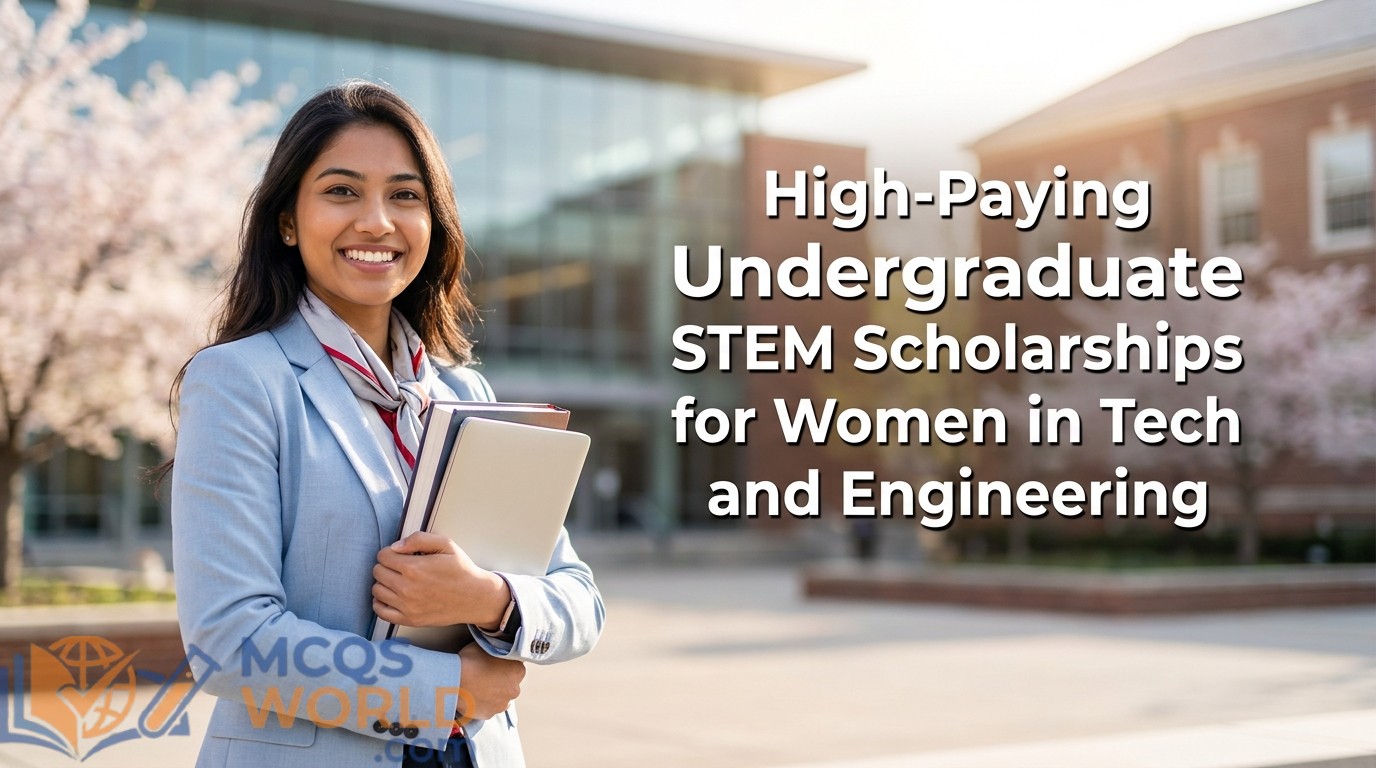
If you’ve ever stared at a tuition bill and then at a computer science or engineering course catalog and wondered how the two could possibly coexist, you are not alone. Women make up a shrinking minority of engineering and computing degree-holders relative to their share of the overall student population, and the tuition gap doesn’t discriminate — it hits every applicant the same way, regardless of talent or ambition. The good news is that hundreds of organizations, from Fortune 500 tech companies to century-old professional societies, have built scholarship programs specifically to close that gap.
This guide is built for one purpose: to help you find and win real money for your STEM education. You’ll walk away knowing exactly which high-value scholarships exist for undergraduate women in technology and engineering right now, what each one actually requires, how the application process works step by step, which documents to prepare in advance, the mistakes that quietly sink strong candidates, and answers to the specific questions students ask most often. Whether you’re a rising freshman choosing a major or a junior looking to fund your final two years, treat this as your working checklist, not just background reading.
Why Women-Specific STEM Scholarships Matter Right Now
Scholarship committees didn’t invent women-only STEM awards to check a diversity box. They exist because the numbers still tell a clear story: women earn well under a third of bachelor’s degrees in fields like computer science and electrical engineering, even though female enrollment in college overall outpaces men’s. Tuition for ABET-accredited engineering programs and computer science degrees at research universities regularly runs into six figures over four years once you factor in lab fees, software licenses, and specialized equipment — costs that hit STEM majors harder than students in most other fields.
Funders like the Society of Women Engineers, Microsoft, Palantir, and Hyundai treat these scholarships as workforce investments, not charity. A engineering firm that funds ten women through a mechanical engineering degree is, in a very direct sense, building its own future talent pipeline. That’s why many of these awards come bundled with mentorship, internship pathways, and networking access that can matter more long-term than the check itself.
Consider a composite example based on patterns seen across real recipients: a sophomore majoring in computer science at a mid-sized state university applies to five scholarships in one cycle using a single strong personal statement, adapted slightly for each application. She’s rejected by two, wait-listed by one, and wins two — a $2,500 award from a professional society and a $10,000 corporate scholarship that includes a summer internship interview. The internship converts into a return offer before she graduates. The scholarship money mattered, but the internship pipeline it opened mattered more. That’s the pattern this guide is designed to help you replicate.
It’s also worth understanding why these awards cluster so heavily around engineering, computer science, and related technical majors specifically, rather than STEM broadly. Biology and general science majors already see closer-to-parity enrollment between men and women at the undergraduate level in many programs, while computing and several engineering disciplines remain the fields where the gender gap is widest and most persistent. Funders concentrate dollars where the representation gap — and therefore the potential impact of a single scholarship — is largest. That’s precisely why a computer science or mechanical engineering major will typically find a deeper, richer pool of women-specific funding than a biology or environmental science major will, even though both technically fall under the STEM umbrella.
This also means timing your applications around your specific major and year in school matters more than most students realize. A freshman engineering major should be tracking “Emerging First Year” style awards and corporate freshman-friendly scholarships, while a junior should be shifting focus toward upperclass-only awards that carry higher dollar amounts and often value internship or research experience more heavily in the review process.
The Complete Breakdown: Top Undergraduate STEM Scholarships for Women
Below is a detailed look at some of the highest-value, most established scholarships open to undergraduate women pursuing tech and engineering degrees. Amounts, deadlines, and eligibility details shift slightly year to year, so always confirm the current cycle’s specifics on the official scholarship page before you submit anything.
1. Society of Women Engineers (SWE) Scholarship Program
Overview: SWE runs the largest scholarship program of its kind for women in engineering and technology, distributing well over a million dollars annually across more than 200 individual awards through a single unified application.
Financial Coverage: Individual awards typically range from around $1,000 up to $20,000 depending on the specific named scholarship you’re matched with; SWE awarded roughly $1.6 million across more than 330 scholarships in a recent cycle.
Eligibility: Open to women/female-identifying students planning to study in an ABET-accredited engineering, computing, or technology program. Undergraduates should be entering their sophomore, junior, or senior year (a separate “Emerging First Year” track exists for incoming freshmen and high school seniors). Applicants must not already be fully funded for tuition, fees, and books.
Required Documents: Unofficial transcript, two letters of recommendation (one academic, one personal), a resume, and short response essays through the online application.
Application Timeline: The Collegiate/Graduate application window generally opens in December and closes toward the end of February through late March, with the Emerging First Year track opening a bit later in the spring. Because SWE reuses one application across hundreds of individual named awards, apply as early in the window as possible — earlier submissions get matched against the fullest pool of open scholarships.
2. Palantir Women in Technology Scholarship
Overview: Funded by data-analytics company Palantir Technologies, this award targets underclasswomen early in their STEM journey and pairs funding with direct engineering mentorship.
Financial Coverage: Up to $10,000 toward educational costs.
Eligibility: Full-time undergraduate women enrolled at an accredited U.S., Canadian, or Mexican college or university, currently a freshman, sophomore, or junior, and majoring or planning to major in a STEM field.
Required Documents: Online application, transcript, and a short written response about your interest in technology.
Application Timeline: Deadline typically falls in mid-March; apply through Palantir’s official scholarship page and confirm the current year’s exact date before submitting.
3. Microsoft “Women at Microsoft” Scholarship
Overview: A cohort-based award from Microsoft designed to fund tuition while connecting winners with mentors inside the company.
Financial Coverage: Seven scholarships of $5,000 each per cycle.
Eligibility: Women enrolled or planning to enroll full-time at an accredited two- or four-year U.S. college studying a computer science, computer engineering, or related technical field.
Required Documents: Application form, transcript, and short essay responses about career goals and interest in technology.
Application Timeline: Deadline generally falls in mid-March. Applications open through Microsoft’s official scholarship portal each academic year.
4. Science Ambassador Scholarship (funded by Cards Against Humanity)
Overview: One of the largest fully-funded scholarships available to women pursuing STEM undergraduate degrees, and unusual in its application format.
Financial Coverage: Full tuition for an undergraduate degree in science, engineering, or math.
Eligibility: Open to women and non-binary students pursuing an undergraduate STEM degree.
Required Documents: Instead of essays, applicants submit a roughly three-minute video explaining a STEM topic they’re passionate about in an engaging, accessible way — think “explain it like you’re teaching a curious friend.”
Application Timeline: The application window typically opens in the fall, with decisions announced in December for the following academic year. Because the format is video-based, budget real production time — a rushed, poorly lit video competes against genuinely polished submissions.
5. Amazon Future Engineer Scholarship
Overview: Amazon’s flagship scholarship for first-generation and financially underserved students heading into computer science, open to all genders but consistently a strong option for women given the emphasis on financial need and underrepresentation.
Financial Coverage: $40,000 total (paid over four years), plus a guaranteed paid internship offer at Amazon after freshman year.
Eligibility: U.S. high school seniors planning to major in computer science, computer engineering, or a closely related field, who demonstrate financial need and hold at least a 2.3 GPA.
Required Documents: Online application, transcript, financial need documentation (typically FAFSA-based), and short essays.
Application Timeline: Deadline is typically in mid-to-late January for students entering college that fall.
6. Hyundai Women in STEM Scholarship
Overview: A straightforward, generous award aimed at boosting representation in engineering, computer science, and related technical majors.
Financial Coverage: Five scholarships of $10,000 each.
Eligibility: U.S. high school seniors and current undergraduates who identify as female and are pursuing a STEM-related degree.
Required Documents: Application form, transcript, and personal statement.
Application Timeline: Deadlines vary by cycle; check the current opening date on the official award page, as this scholarship rotates its exact timeline year to year.
7. IEEE Women in Engineering International Scholarship
Overview: Backed by the Institute of Electrical and Electronics Engineers, this award supports women at multiple academic stages, from pre-university through graduate study, with a focus on engineering disciplines.
Financial Coverage: $2,500.
Eligibility: Female students at the pre-university, undergraduate, or graduate level pursuing an engineering degree.
Required Documents: Application form, academic transcript, and a personal statement about engineering career goals.
Application Timeline: Deadlines are set annually through IEEE’s Women in Engineering portal; international applicants are welcome, which makes this a strong option if you’re studying outside the U.S.
8. Adobe Research Women-in-Technology Scholarship
Overview: Adobe’s award specifically targets undergraduate women in computer science and software engineering, pairing funding with mentorship from Adobe engineers and researchers.
Financial Coverage: Award amount varies by cycle; funding is paired with mentoring and networking opportunities with Adobe’s technical staff.
Eligibility: Undergraduate women studying computer science or software engineering with a strong academic record and demonstrated leadership.
Required Documents: Application, transcript, resume, and short essay responses.
Application Timeline: Check Adobe’s official research scholarship page each year, as the window opens and closes on a rotating annual schedule.
9. BHW Group Women in STEM Scholarship
Overview: A dependable, accessible award for undergraduate and graduate women across the full range of STEM majors, paid directly to the student or their institution.
Financial Coverage: $3,000.
Eligibility: Women pursuing an undergraduate or graduate degree in a STEM field — including computer science, engineering, and information technology — at an accredited U.S. institution.
Required Documents: Online application and a short essay.
Application Timeline: Deadline is generally in mid-April; apply through the official BHW Group scholarship page.
10. Aysen Tunca Memorial Scholarship (Society of Physics Students)
Overview: A smaller but competitive award specifically for women in physics-adjacent STEM fields, with preference given to first-generation and disadvantaged applicants.
Financial Coverage: Approximately $2,000–$2,500.
Eligibility: Female undergraduate students majoring in a STEM field who are current members of the Society of Physics Students, preferably first-generation college students or from disadvantaged backgrounds.
Required Documents: SPS membership confirmation, transcript, and a short personal statement.
Application Timeline: Deadline typically falls in mid-March.
Required Documentation and How to Prepare It Professionally
Almost every scholarship on this list asks for some combination of the same core documents. Building a “scholarship folder” once and reusing it saves enormous time across a busy application season.
Transcripts. Request an unofficial transcript from your registrar’s portal first — most scholarship committees accept these for initial review and only request an official, sealed copy if you win. Keep both a PDF and a printed copy on hand, since a handful of local or chapter-level awards still request mailed materials.
Letters of recommendation. Ask recommenders at least four to six weeks before a deadline, not four to six days. Give each recommender a one-page brief listing the scholarship’s focus, your key achievements relevant to it, and the submission deadline — this dramatically improves the quality and specificity of what they write. A STEM-adjacent recommender (a lab instructor, project advisor, or internship supervisor) generally carries more weight than a general academic reference for technical scholarships.
Personal statements and essays. Draft one strong, detailed “master essay” about your STEM journey, then adapt it for each scholarship’s specific prompt rather than starting from scratch every time. Committees can tell the difference between a tailored answer and a copy-pasted generic one within the first two sentences.
Financial documentation. Need-based awards like Amazon Future Engineer typically require FAFSA data or an equivalent need-verification form. Have your FAFSA submitted early in the cycle so this documentation is ready whenever a scholarship asks for it.
Video or creative submissions. For format-specific awards like the Science Ambassador Scholarship, treat production quality as part of the application. A phone camera in good lighting with a clean background and a rehearsed (not memorized-sounding) explanation outperforms an unedited, poorly lit ramble every time.
Common Mistakes to Avoid and Insider Tips
Mistake 1: Applying only to the biggest-name scholarships. Massive, well-known awards like Amazon Future Engineer and SWE’s program attract enormous applicant pools. Balance your list with smaller, less-publicized chapter-level or field-specific awards (like local SWE section scholarships or professional-society niche awards), where competition is far thinner and win rates are meaningfully higher.
Mistake 2: Missing the “not fully funded” clause. Several major awards, including SWE’s program, explicitly require that you not already be fully funded for tuition, fees, and books. Read every eligibility line closely — this single clause disqualifies otherwise-strong applicants who skip it.
Mistake 3: Submitting a generic, unfocused essay. Committees fund people, not majors. Anchor your essay in one specific project, competition, internship, or moment that shows why you chose this STEM path, rather than a broad statement about “loving science since childhood.”
Mistake 4: Waiting until senior year to start applying. Many of the highest-value awards, including SWE’s and Palantir’s, are open to sophomores and juniors. Starting early means more total cycles, more practice, and more cumulative funding by graduation.
Mistake 5: Ignoring professional-society membership requirements. Awards tied to organizations like the Society of Physics Students or IEEE often require active membership before you can apply. Join early — some memberships take days to process, and a late join can knock you out of a deadline entirely.
Insider tip: Build a single tracking spreadsheet with columns for scholarship name, amount, deadline, required documents, and application status. Update it weekly. Students who systematically track deadlines apply to noticeably more scholarships per cycle than those relying on memory or bookmarks, simply because nothing falls through the cracks.
Insider tip: Reuse recommenders strategically. If two scholarships share a deadline window, ask the same recommender to write once and lightly tailor it, rather than requesting entirely separate letters — this respects their time and keeps your relationship strong for future asks.
Insider tip: Look beyond national scholarship lists for chapter-level and regional awards. Local sections of SWE, IEEE, and other professional societies often run their own smaller scholarships on top of the national program, and many students never think to check whether their nearest chapter has a separate application. These regional awards are frequently underapplied-to relative to the money available, simply because they don’t show up on the big national scholarship search engines.
Mistake 6: Treating the essay as an afterthought compared to the resume. Many applicants pour their energy into polishing GPA and activity lists while writing the essay in a single rushed sitting the night before the deadline. Committees reviewing hundreds of similarly qualified STEM resumes usually make their final decision based on the essay, since it’s the one place where your voice, motivation, and future plans actually come through. Draft it early, set it aside for a few days, then revise it with fresh eyes, and if possible, have a teacher, mentor, or writing center review it before you submit.
Comprehensive FAQ
Can I apply for these scholarships if my GPA is below 3.0?
Yes, some can. Most SWE Collegiate/Graduate awards set a 3.0 minimum, but need-based awards like Amazon Future Engineer accept a GPA as low as 2.3 when paired with demonstrated financial need. Always check the specific GPA floor listed for each award rather than assuming a blanket standard across all STEM scholarships.
Do I need to be a U.S. citizen to apply?
It depends on the award. Programs like SWE’s scholarship extend to eligible programs internationally, and IEEE’s Women in Engineering scholarship is explicitly open to international applicants. Corporate scholarships like Amazon Future Engineer, however, generally require eligibility to work in the United States, so check citizenship and work-authorization requirements line by line.
Can I apply for multiple scholarships on this list in the same year?
Absolutely, and you should. Nearly all of these awards allow you to hold and apply for other scholarships simultaneously. Just watch for any award that explicitly requires exclusivity or full funding disqualification, since a small number of programs do restrict stacking.
What if my major is STEM-adjacent but not a core engineering or computer science field?
Many awards, including BHW Group’s scholarship and several SWE-affiliated awards, define STEM broadly enough to include fields like data science, information technology, and applied mathematics. Read the eligible-majors list carefully; when in doubt, email the scholarship coordinator directly and ask before assuming you don’t qualify.
Is community college enrollment a disqualifier?
Not universally. Some chapter-level SWE scholarships and several state or regional awards explicitly welcome community college students, particularly those planning to transfer into a four-year engineering or computing program. National corporate scholarships are more likely to require four-year enrollment, so check each award’s specific language.
How early should I start preparing my application materials?
Begin at least two months before your target deadlines. That gives recommenders enough lead time, lets you draft and revise essays more than once, and leaves room to request an official transcript if a scholarship needs one on short notice after a win.
Do these scholarships renew automatically each year I’m in school?
Rarely automatically, but often by reapplication. Programs like SWE and several university-based awards allow past winners to reapply in later years, though renewal isn’t guaranteed and typically depends on maintaining your GPA and program eligibility.
Conclusion and Your Next Steps
Funding a STEM degree as a woman in tech or engineering is genuinely more expensive than the average undergraduate path, but it is also one of the most heavily supported areas of scholarship funding available today. The scholarships covered here — from SWE’s massive multi-award program to Amazon’s $40,000 Future Engineer award — represent real, currently active funding you can apply for this cycle, not aspirational listings.
Your next move is simple: pick the five scholarships from this list that best match your year in school and major, build your document folder this week, and set calendar reminders for each deadline well ahead of time. Bookmark this guide so you can return to it as deadlines approach, and keep exploring further scholarship and application resources on mcqsworld.com as you build out your full funding strategy. The money exists — the students who win it are simply the ones who applied.