



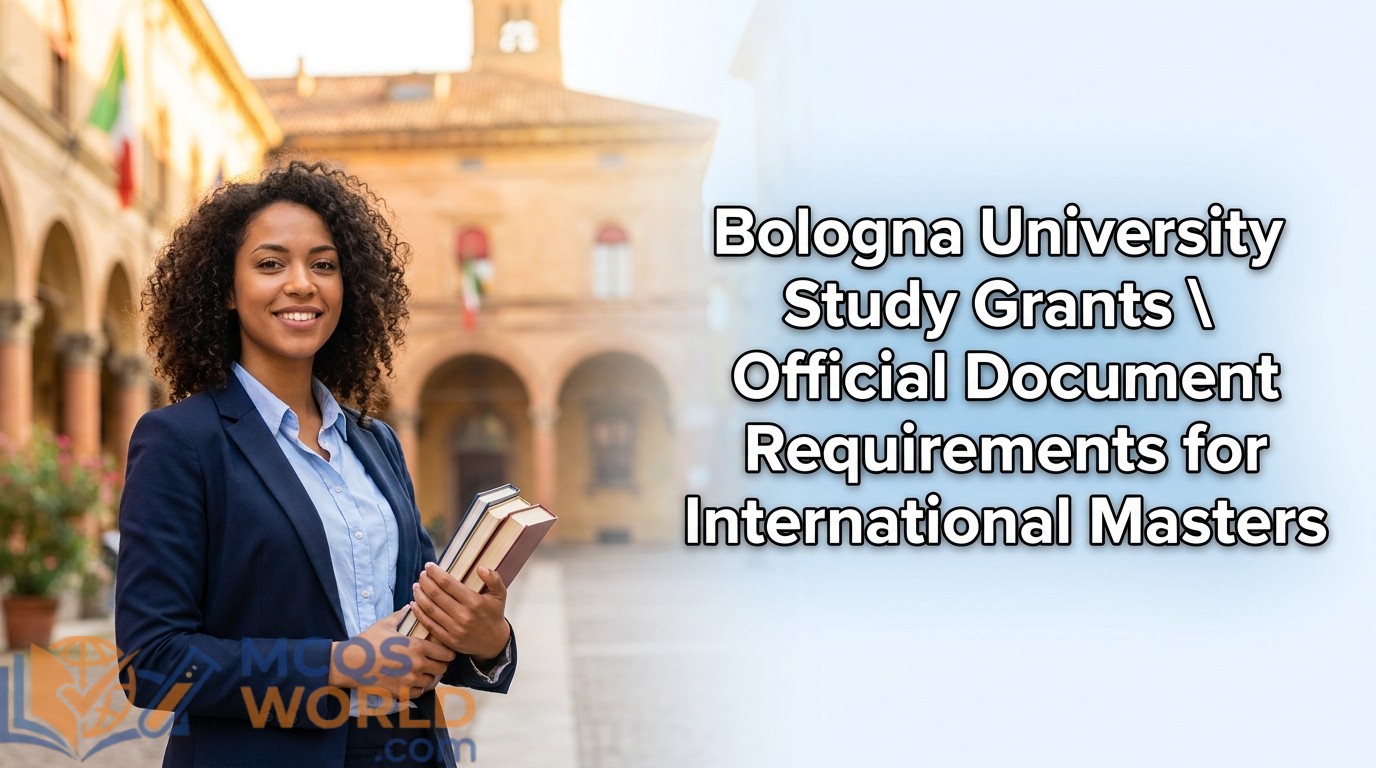
If you’re looking into funded master’s study in Italy, the University of Bologna’s main scheme for international students is called International Talents @Unibo. It’s a study grant plus tuition waiver for students entering a second-cycle (master’s) degree program, and it runs on a fairly specific document checklist that’s worth understanding before you start gathering paperwork.
This guide covers what the grant actually pays, who qualifies, exactly which documents you need, how the application runs through Bologna’s own systems, and how to avoid the scam and misinformation traps that circulate around it every cycle.
Why This Grant Is Worth Knowing About
The University of Bologna is the oldest continuously operating university in the Western world, founded in 1088, and it still carries serious weight in European academia today. For an international student without EU citizenship, that history comes with a real practical problem: non-EU tuition and living costs in Italy add up fast, and financing a full master’s degree from another continent is genuinely hard without support.
International Talents @Unibo exists to close part of that gap specifically for strong applicants. It’s aimed squarely at students entering second-cycle degree programs — Italy’s term for a standard master’s, as distinct from first-cycle (bachelor’s) or single-cycle (integrated) degrees. Because eligibility depends on your prior education being from outside the Italian system, it’s built for people making a genuine international move, not students already inside Italian higher education.
Getting one of these grants does more than cover costs. Full tuition exemption at a research university with Bologna’s reputation, combined with a cash stipend, means you can treat the two years primarily as academic time rather than working to cover rent and fees. That matters if your plan includes a thesis, lab work, or building toward a PhD afterward — the kind of goals that are hard to pursue properly while juggling part-time jobs to stay afloat.
Quick Reference Table
| Detail | Information |
| Program name | International Talents @Unibo |
| Degree level | Second-cycle (master’s) degree programs only |
| Grant value | €6,500 gross per year (most recent confirmed cycle; amount changes year to year — verify the current call) |
| Tuition | Full waiver, though a small mandatory fee (around €157) for regional tax, stamp duty, and insurance still applies |
| Duration | Awarded for two academic years, subject to merit conditions in year two |
| Required test | GRE (General Test), sent to Bologna using recipient code 7850 |
| Financial check | ISEE (Italian financial-status indicator) between roughly €16,000–€35,000, or an equivalent for students without Italian tax records |
| Age limit | Under 30 on the application deadline |
| Application platform | Studenti Online (studenti.unibo.it) |
| Typical deadline | Late May, around noon CEST (varies by year — always confirm against the current call) |
| Results | Typically announced in July |
Who Actually Qualifies
International students by education, not necessarily by citizenship. The defining criterion isn’t your passport — it’s where your prior qualification comes from. You need to hold, or be close to completing, a degree from an institution outside the Italian education system that qualifies you for the master’s program you’re applying to. Students with a diploma from an Italian school located abroad can also apply under this rule.
Students under 30 at the deadline. This is a hard cutoff tied to the closing date of that year’s call for applications, not to when you’d start or finish your studies.
Students who’ve taken the GRE. Unlike a lot of European scholarships, this one requires the GRE General Test specifically — not IELTS or TOEFL, which cover English proficiency but don’t substitute here. You need a valid score sent to Bologna before the deadline, and recent cycles have applied minimum thresholds on the Verbal, Quantitative, and Analytical Writing sections.
Students who can document a specific financial band. This program targets students within a defined income range using Italy’s ISEE indicator (or an equivalent if you don’t have Italian financial records) — generally somewhere in the €16,000 to €35,000 zone in recent cycles. It’s a merit-and-need hybrid: strong GRE performance matters, but so does verified financial status.
First-time matriculants, not continuing or transfer students. The grant is for students starting fresh in the first year of a second-cycle program. Enrolling in a later year, switching programs, or transferring in from another university doesn’t count as matriculation under Bologna’s own student regulations, and won’t qualify you.
Required Documents: The Real Checklist
This is where a lot of applicants lose time, so it’s worth being precise:
A valid passport copy. EU citizens can submit a national ID card instead.
Your qualifying degree certificate and full transcripts. This includes records of completed exams and grades from your prior institution, and it needs to demonstrate the qualification is valid for entry to your specific chosen master’s program.
An unofficial GRE score report, with your official scores sent separately and directly to the university via ETS using recipient code 7850. Both pieces matter — the report you upload and the official score feed need to align.
Proof of financial status. If you have an Italian ISEE, that’s the primary document. If you don’t — which is the normal case for most international applicants — you’ll need an equivalent certification of your family’s financial situation, since Bologna cross-checks self-declared financial status and reserves the right to audit it.
Language of documents. Everything you submit needs to be in English, Italian, French, or Spanish. If your originals are in another language, you’ll need certified translations before you upload anything.
One detail that trips people up: this scholarship application is separate from your degree program application. Submitting the International Talents @Unibo form doesn’t get you admitted to a master’s program — you still need to apply to and be accepted into the specific program separately, on its own timeline and through its own admissions process.
How the Application Actually Runs
Step 1: Register on Studenti Online. If you don’t already have Bologna credentials (or Italian digital identity via SPID or CIE), you create an account at studenti.unibo.it under the international student registration option, since you won’t have an Italian tax code yet.
Step 2: Confirm and correct your registration details. Make sure the personal information on your account matches your passport or ID exactly — mismatches here are a common cause of processing delays.
Step 3: Find and select the correct call. Once logged in, go to “Calls” and select the specific International Talents @Unibo call for the relevant academic year. Naming conventions shift slightly year to year, so match the exact academic year in the call title to the year you’re applying for.
Step 4: Complete the form and upload documents. Fill in every required field and attach your documents as PDFs — passport, transcripts, degree certificate, and financial documentation.
Step 5: Send your official GRE scores separately. Register your scores through ETS and direct them to Bologna’s recipient code 7850, timed so they arrive before the application deadline — this doesn’t happen automatically just because you uploaded an unofficial report.
Step 6: Review everything before the cutoff. Applications submitted by post, fax, or direct email aren’t accepted; the online portal, completed correctly before the deadline (typically noon CEST in late May), is the only valid channel.
Step 7: Wait for results. Bologna typically announces outcomes around July, contacting successful applicants by email at the address on file. If you’re awarded a grant, you then proceed with your separate degree enrollment for the autumn semester.
There’s no advance payment and no way to “reserve” a grant before results are published — the process runs entirely on the published timeline, with no shortcut around it.
Avoiding Scams and Bad Information
This scholarship’s popularity has generated a lot of low-quality secondary content, and a few of those pages actively conflict with the university’s own published terms. A few checks worth running before you trust any source:
Cross-check dollar figures against the official call PDF, not aggregator summaries. As noted above, several third-party sites list amounts (€11,000, €13,000) that don’t match Bologna’s own confirmed figures for recent cycles. When in doubt, find the actual call-for-applications document on bandi.unibo.it rather than trusting a blog’s number.
There’s no fee to apply for the scholarship itself. The only payment involved anywhere in this process is the small mandatory regional tax and insurance fee (around €157) that applies even to grant recipients — that’s a university-wide requirement, not a scholarship processing charge. Any site asking for money to “submit,” “process,” or “guarantee” your scholarship application is not affiliated with the university.
Applications only happen through studenti.unibo.it. If a site offers you a scholarship application form hosted anywhere else, treat that as a red flag, especially if it also asks for sensitive documents like passport scans outside the official portal.
The scholarship application does not replace your degree application. Be suspicious of any source implying that submitting the scholarship form alone gets you admitted — that’s not how the two processes relate.
Verify test requirements directly. This program requires the GRE specifically. If a source tells you IELTS or TOEFL alone will satisfy the scholarship’s testing requirement, double-check against the current call before you skip GRE preparation.
Frequently Asked Questions
Does the scholarship application also serve as my program admission application?
No. The International Talents @Unibo form is solely a scholarship request. You need to separately apply for admission to your chosen master’s program through that program’s own application process and deadlines, and both need to succeed for you to actually enroll with funding.
What if I don’t have an Italian ISEE certificate?
That’s the normal situation for most international applicants, and the process accounts for it — you submit an equivalent certification of your financial status instead. Exactly what counts as equivalent can vary, so it’s worth checking the specific current-year call for the accepted documentation format rather than assuming any financial letter will do.
Is IELTS or TOEFL enough, or do I really need the GRE?
You need the GRE specifically for this scholarship — it’s the merit test the selection process is built around, not a general English proficiency requirement. IELTS or TOEFL may still be required separately by your chosen master’s program for language purposes, but neither substitutes for the GRE in the scholarship application itself.
Can I apply for the scholarship before I’m admitted to a master’s program?
Generally the scholarship call is designed for applicants who are in the process of applying to or already have a qualification suited to an eligible second-cycle program, so you should be pursuing both processes in parallel rather than waiting for full admission before starting your scholarship paperwork — but always check the specific timing requirements in the current year’s call.
Is the tuition waiver really completely free, with no costs at all?
Not entirely. Full tuition is waived, but a small mandatory charge — historically around €157 — still applies for regional tax, stamp duty, and insurance. That’s a standard fee for all students at Italian public universities and isn’t specific to this scholarship or a sign of a scam.
What happens if my grades slip in the first year?
The grant runs for two years but renewal into the second year is conditional on meeting merit requirements during the first. If you fail to maintain the required academic progress, you can lose the funding for year two even after being awarded it initially, so it’s worth treating the first year’s performance as directly tied to your funding, not just your degree progress.
How many scholarships are actually available each cycle?
This varies year to year — recent cycles have offered around 30 grants, and an earlier cycle funded 56 at a lower per-grant amount. Because both the number of awards and the value per award shift between cycles, don’t rely on a prior year’s figures when planning your application; check the current call for applications for the exact numbers.
Where do I find the authoritative, current version of all of this?
The University of Bologna publishes official calls for applications as PDFs on bandi.unibo.it, and its general study-grants overview lives on unibo.it under “Study grants and subsidies.” Treat those two as your source of truth, and use scholarship-listing sites only as a discovery tool, not a final reference.
Figures, deadlines, and requirements above reflect the most recently confirmed official call for applications as of 2026 and change from cycle to cycle. Always verify current-year details directly against the University of Bologna’s official call for applications before submitting anything.