




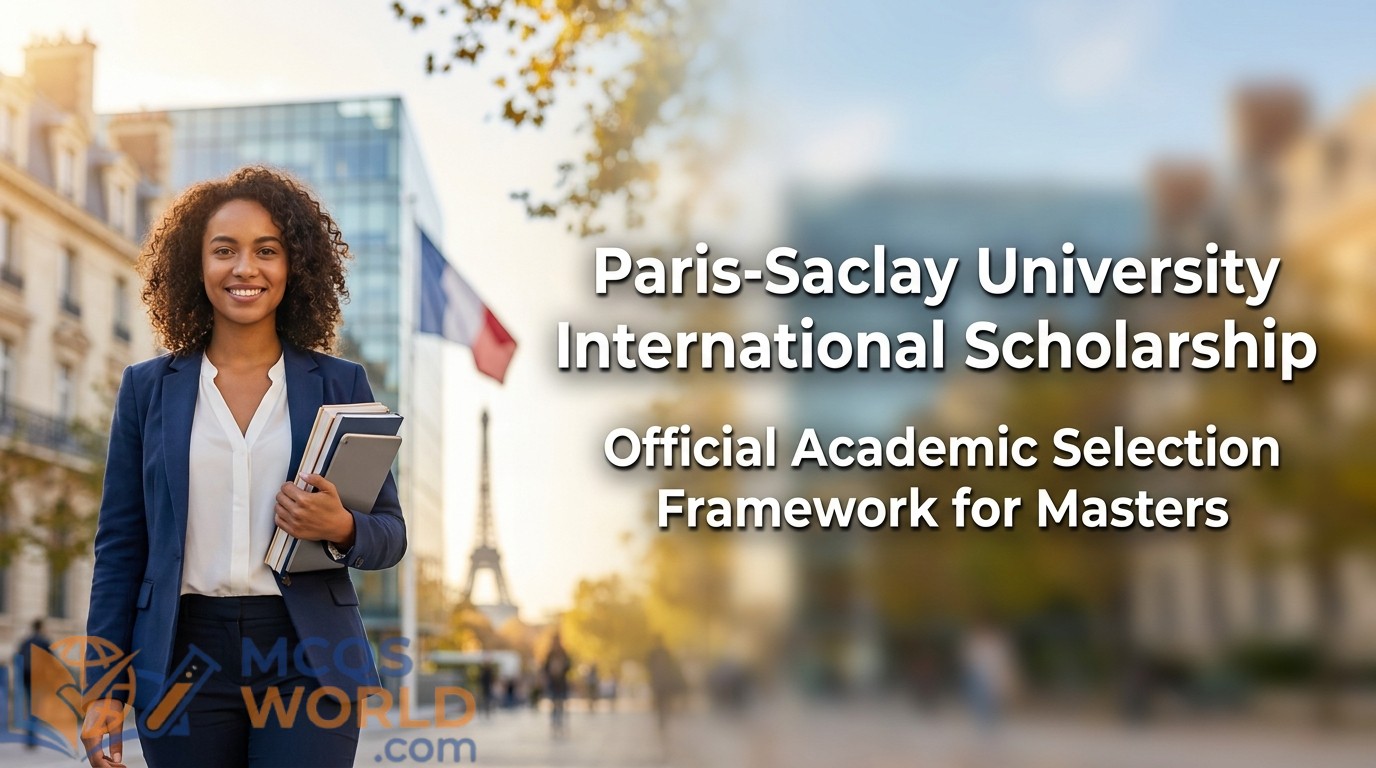
If you’re researching funded master’s options in France, the International Master’s Scholarship at Université Paris-Saclay is worth understanding properly, because the way it works catches a lot of applicants off guard. You don’t apply for it directly. You apply to a master’s program first, and the scholarship application only opens up to you if the program invites you into it. That single detail changes how you should plan your whole application timeline.
This guide walks through what the scholarship is, who it’s built for, exactly how the process runs, what it pays, and how to tell the real thing apart from the recycled scholarship-blog content that circulates every admissions cycle.
Why This Scholarship Matters
Université Paris-Saclay is one of France’s flagship research universities, built from a cluster of grandes écoles and research institutes rather than a single traditional campus. That structure is part of why the scholarship exists: the university wants to pull in strong international students who might eventually stay for a PhD, so the funding is deliberately aimed at people with a research trajectory in mind, not just anyone looking for a master’s degree in Europe.
For an international student, a scholarship like this solves the two biggest practical problems of studying abroad at once. It covers a meaningful chunk of living costs, and it gets you inside a research ecosystem — labs, faculty, PhD pipelines — that’s much harder to access from outside France. If your longer-term goal is a doctorate, being funded through a master’s at an institution like this can matter more for your trajectory than the master’s degree itself.
Quick Reference Table
| Detail | Information |
| Provider | Université Paris-Saclay (IDEX-funded program) |
| Eligible institutions | AgroParisTech, CentraleSupélec, ENS Paris-Saclay, INSTN-CEA, IOGS, Université Évry Paris-Saclay, Université Paris-Saclay, UVSQ |
| Degree levels | M1 (first year) and M2 (second year) master’s |
| Excluded programs | Vocational/apprenticeship programs (“formations en apprentissage”) |
| Award amount | €10,000 per year, paid monthly September to June |
| Extra support | Up to €900/year toward travel and visa costs (amount varies by country of origin) |
| Renewal | Automatic into M2 for M1 laureates who complete required credits |
| Application method | Invitation-only, after admission to an eligible master’s program |
| 2026 key dates | Program coordinators select candidates by 25 March 2026, 11:59pm (Paris time); scholarship application and references due 31 March 2026, 11:59pm |
Who This Scholarship Is For
International students admitted to an eligible Paris-Saclay master’s program. You have to clear regular master’s admission first — the scholarship sits downstream of that, not alongside it. All academic fields count, across the affiliated institutions listed above, with the single exception of apprenticeship-style vocational programs.
Students in their first real stint at a French institution. The eligibility rules are specific here: you generally need to be a foreign national who hasn’t previously been enrolled in a French higher education institution. There are carve-outs for people who were in France on an exchange, on an Erasmus Mundus joint degree that didn’t award a French qualification, doing an internship, or taking language classes — none of those count against you.
Students under 30 in the year they apply. This age ceiling applies at the point of application, not at graduation, so plan your timeline around when you submit rather than when you’d finish the degree.
Students without significant existing funding. If you’re already receiving support worth more than €600 a month from another source, you become ineligible for this one. It also can’t be combined with France Excellence Eiffel, France Excellence Europa, or Erasmus Mundus scholarships — you’d need to pick a lane.
Refugee and subsidiary-protection students, specifically. Université Paris-Saclay runs a bonus system for this group in partnership with UNHCR and the MEnS association (Migrants dans l’Enseignement supérieur). If this applies to you, the advice from the university is to say so in your statement of purpose from the moment you apply to the master’s program — not to wait until the scholarship stage.
How the Process Actually Works, Step by Step
Step 1: Apply to an eligible master’s program. This is the real starting line. You go through Université Paris-Saclay’s standard master’s admissions process, choosing a program at one of the affiliated institutions. There’s no separate scholarship account to create at this stage — you’re just applying for the degree.
Step 2: Wait for the program coordinators’ selection. Each master’s program has its own coordinators who decide which admitted students get put forward for the scholarship. This is a filter you don’t control directly; it’s based on how competitive your admission file looked.
Step 3: Receive an invitation email. If you’re shortlisted, Université Paris-Saclay emails you a link to the scholarship application form. This is an important checkpoint for spotting fraud — legitimate contact comes from the university itself, tied to a master’s application you already submitted, not from an unsolicited email or a third-party portal you stumbled across online.
Step 4: Complete the scholarship application, including references if asked. Some applicants are asked to name two referees — a professor, course coordinator, or internship supervisor — who submit a recommendation online. You’ll get confirmation that a reference was received, but you won’t see its contents.
Step 5: A jury reviews your file. A jury made up of Graduate School representatives evaluates applications on academic performance, your personal project, and — for M2 candidates specifically — your motivation for pursuing a PhD. The jury’s decisions are discretionary, confidential, and final; there’s no appeals process, so put real care into your statement of purpose the first time.
Step 6: Get notified by email. Every applicant to the scholarship program is informed of the jury’s decision by email, whether the outcome is positive or not.
Step 7: Funding starts after you arrive and register. No advance payments are made under any circumstances. Once you’ve physically arrived in France and completed enrollment in your program, the monthly stipend and the travel/visa flat fee begin.
Because eligibility for a given year runs through the master’s program’s own admissions calendar, the two deadlines that matter most are the date your program coordinators finalize their candidate selection, and the date shortly after when the scholarship application and any references are due. For the 2026 cycle, those fall on 25 March and 31 March respectively — but always confirm current-year dates directly with the university, since they shift annually.
What the Scholarship Actually Pays
The award is €10,000 per year, paid out monthly from September through June — not as a lump sum. On top of that, laureates get a flat annual amount of up to €900 toward travel and visa costs, with the exact figure depending on your country of origin.
If you’re admitted in M1 and complete the required credits, the funding automatically carries over into M2 without a fresh application. During periods spent abroad — compulsory international mobility, or internships outside a Paris-Saclay-affiliated lab — the payment amount is reduced. The university also offers support with administrative procedures and help searching for accommodation, though it’s explicit that it can’t guarantee you a place to live; that search is still on you.
How to Avoid Scam Listings for This Scholarship
Scholarship names like this one attract a lot of secondary content — aggregator sites, “scholarship news” blogs, and outright phishing pages that copy the real eligibility details and then ask for a processing fee, a deposit, or your personal documents up front. A few practical checks:
There is no direct application form for this scholarship. If a site lets you “apply now” for the scholarship itself, without first going through Paris-Saclay’s master’s admissions process, that’s a mismatch with how the real program works. You cannot skip the master’s admission step.
The university never asks for money to consider your application. No legitimate scholarship stage — the master’s application, the coordinator selection, or the scholarship review itself — charges a processing fee. Any request for payment tied to “securing your scholarship” or “confirming your spot” is a scam signal.
Funding is paid after arrival, never in advance. Be skeptical of anything claiming you’ll receive scholarship money before you’ve arrived in France and registered — that directly contradicts how the university structures payments.
Check the domain. The official information sits on universite-paris-saclay.fr. Third-party scholarship-listing sites can be a fine starting point for discovery, but treat them as pointers, not sources of truth — cross-check any date, amount, or requirement against the university’s own page before you act on it.
Be wary of unsolicited emails claiming to offer you the scholarship out of nowhere. The real invitation only goes to students who’ve already submitted a master’s application. If you get scholarship contact with no prior application on your end, don’t engage with it.
Frequently Asked Questions
Can I apply for this scholarship without applying to a master’s program first?
No. Admission to an eligible Université Paris-Saclay master’s program is the prerequisite for everything else. The scholarship application only becomes available to students who are already admitted and then shortlisted by their program’s coordinators — there’s no standalone scholarship application you can submit independently.
What happens if I’m admitted to the master’s but not selected for the scholarship?
You can still enroll in the program as a self-funded or otherwise-funded student; missing out on this particular scholarship doesn’t affect your admission. It’s worth researching other funding routes in parallel, such as France Excellence Eiffel or Erasmus Mundus, though keep in mind you can’t hold this scholarship alongside those.
Does the age limit apply at application or at graduation?
It applies during the year you apply, based on the eligibility language published by the university. If you’re close to the cutoff, check the current year’s exact wording directly with Paris-Saclay, since interpretation details can matter.
Can I combine this with an internship stipend or part-time work income?
The rule that matters here is the €600/month threshold — if you’re already receiving funding above that amount from another source, you become ineligible. Modest part-time earnings under that threshold are a separate question worth confirming directly with the scholarship office rather than assuming either way.
Do I need to already speak French to apply?
The scholarship’s own eligibility criteria don’t set a French-language requirement — that’s determined by whichever master’s program you’re applying to, since many Paris-Saclay master’s programs are taught in English, particularly in engineering and the sciences. Check the language of instruction on your specific program’s page.
How competitive is selection, realistically?
The university doesn’t publish exact acceptance rates for the scholarship, and the jury’s evaluation is explicitly discretionary. What you can control is the strength of your master’s application itself, since scholarship shortlisting flows from how your program coordinators assess your file, plus the quality of your statement of purpose and, for M2 applicants, how clearly you can articulate a PhD-track motivation.
What if I get invited to apply but miss the scholarship deadline?
Late and email-submitted applications aren’t accepted based on the university’s stated process, so there’s no flexibility built in here. If you’re shortlisted, treat that email and its deadline as fixed and act on it immediately rather than waiting.
Is this the same as the Eiffel Excellence Scholarship?
No, and you can’t hold both. Eiffel is a separate, nationally-run French government scholarship with its own application process and criteria; the Paris-Saclay International Master’s Scholarship is specific to this university and funded through its IDEX program. If you’re eligible for both, you’ll need to weigh which better fits your program and timeline, since combining them isn’t allowed.
Eligibility rules, funding amounts, and deadlines summarized here reflect published information as of 2026 and can change year to year. Always confirm current details directly on Université Paris-Saclay’s official admissions and scholarships pages before applying.